How Five New York Reporters Built a Reader-Funded Newsroom for Their City

*** Every week, we pick apart how the world's best media brands got to where they are. This post is the long read. Growth Curve, our weekly newsletter, is the sharp version: same insight, shorter format, straight to your inbox. Subscribe free here. ***
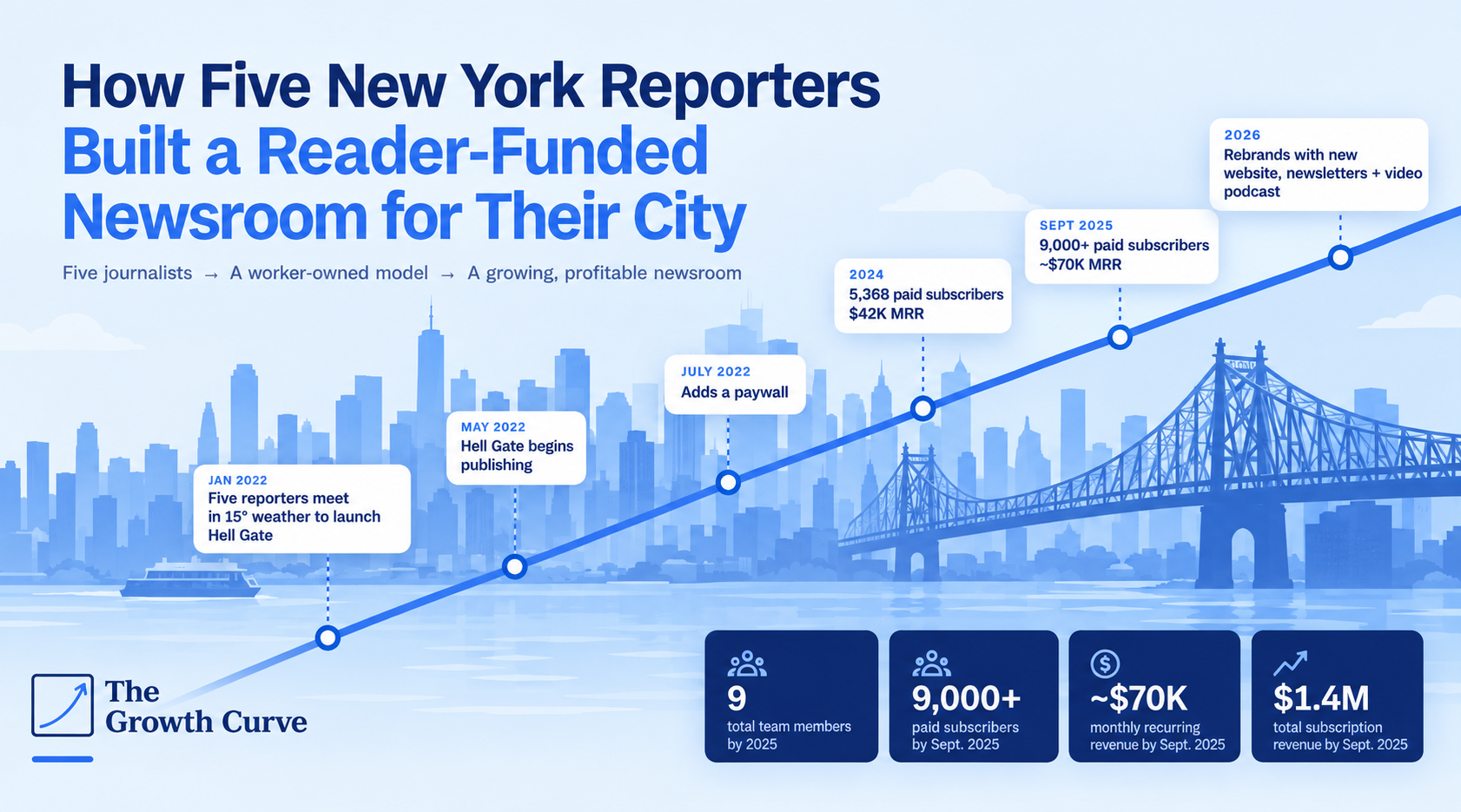
In January 2022, five New York journalists gathered about 50 freelancers outdoors in 15-degree weather to discuss starting a worker-owned local newsroom. The five were Christopher Robbins, Max Rivlin-Nadler, Nick Pinto, Sydney Pereira and Esther Wang. Four of them had worked at Gothamist. Pinto had been a staff writer at The Village Voice, and Wang had been the senior politics reporter at Jezebel. All founders were either newly unemployed or underemployed at the time.
They named the site Hell Gate, after the rail bridge over a stretch of the East River known for strong currents. Two New York foundations provided the seed money: $25,000 from The Harnisch Foundation and $50,000 from the Vital Projects Fund. The site began publishing on May 2, 2022, and added a paywall that July. By September 2025, Hell Gate had more than 9,000 paid subscribers and close to $70,000 in monthly recurring revenue, and the outlet was profitable that year.
A Reader-Funded Cooperative
Every staff member is an owner with a vote on major decisions, and the journalists hold full editorial authority. The site's About page describes its aim as journalism that is useful to readers and deeply skeptical of power. Hell Gate lists every donor who gives more than $5,000 on its website but keeps them out of editorial decisions.
Hell Gate planned to fund its reporting through subscriptions from the outset. Annual plans cost $70, $100, or $200, with the highest tier offering events and merchandise. About a month after introducing its paywall, the outlet had roughly 1,000 paying subscribers and 10,000 newsletter readers. Monthly operating costs were about $20,000, and the founders hoped to pay themselves $4,000 a month.
Three Years of Subscription Growth
In its second year, Hell Gate moved to a hard paywall and redesigned the site to make subscribing easier. Its October 2024 annual report showed 5,368 paid subscribers and $42,000 in monthly recurring revenue, and Nieman Lab reported that subscription revenue had doubled over the year. Subscriptions brought in more than $490,000 across calendar 2024.
The third year added more readers. By the end of September 2025, paid subscribers passed 9,000, up 69%, and monthly recurring revenue reached nearly $70,000, up 66%. Hell Gate projected more than $850,000 in subscription revenue for 2025. On April 9, 2025, it received its millionth dollar in subscription revenue since launch, and the total reached nearly $1.4 million by that September.
More Readers, More Expenses
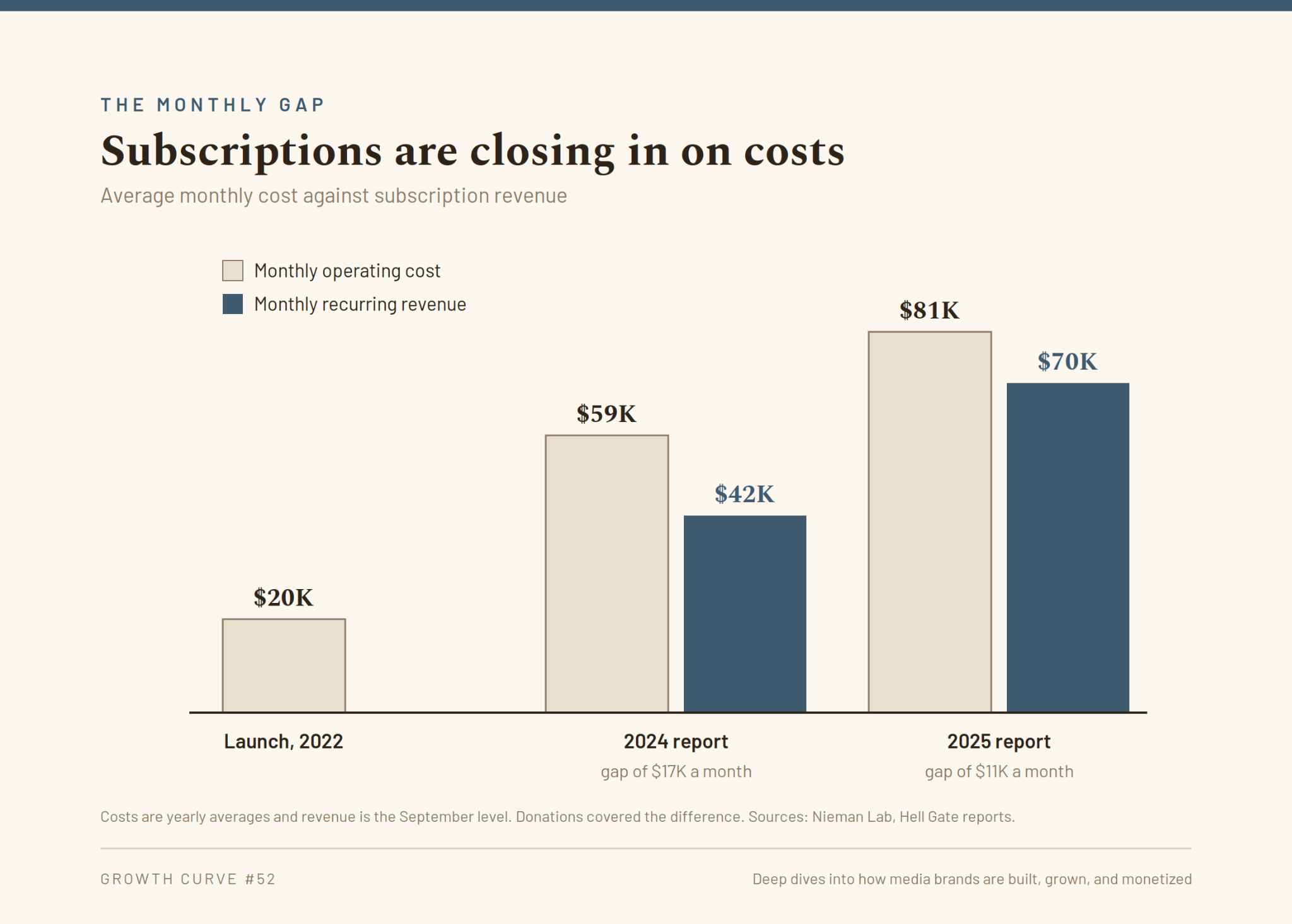
Monthly operating costs grew from about $20,000 at launch to about $59,000 in 2024 and about $81,000 in 2025. Salaries were the largest expense, at nearly $52,000 a month in 2025. Hell Gate's 2024 annual report showed more than $300,000 in philanthropic funding over the previous year. Pinto told Nieman Lab that the founders never trusted philanthropic interests to remain consistent, and that donor support helped bring the outlet closer to break-even.
A July 2025 promotion offered the first month for 99 cents and a free hat, but many subscribers canceled when the regular price took effect. The discount had attracted people unwilling to pay for its journalism. Running a worker-owned newsroom also added to the staff’s workload. Reporter Jessy Edwards told Nieman Lab she was exhausted by the demands of managing the company alongside her reporting.
Hell Gate built its reputation through its reporting on the city government. Its Eric Adams Table of Success, produced with Type Investigations, won a 2024 New York Press Club award for political reporting. In 2023, the outlet found that the NYPD had cited a nonexistent gag order to avoid a City Council hearing on its Strategic Response Group. In April 2025, it reported that Andrew Cuomo’s mayoral campaign had used ChatGPT to draft a housing plan. Its election newsletter, Mayoral Spew, gained more than 40,000 free subscribers.
Team Structure
The staff grew from five cofounders in 2022 to six full-time journalists and a business manager in 2024. By September 2025, the core team had nine people. There were five reporters, two editors, a part-time operations and finance manager, and a part-time marketing and external relations manager. Edwards joined from Gothamist and WNYC in 2025. That May, a WNYC and Gothamist podcast episode built on her earlier reporting about sexual assault at the Rikers Island women's jail was named a Pulitzer Prize finalist in audio reporting. Editor Holly Pretsky joined in 2026.
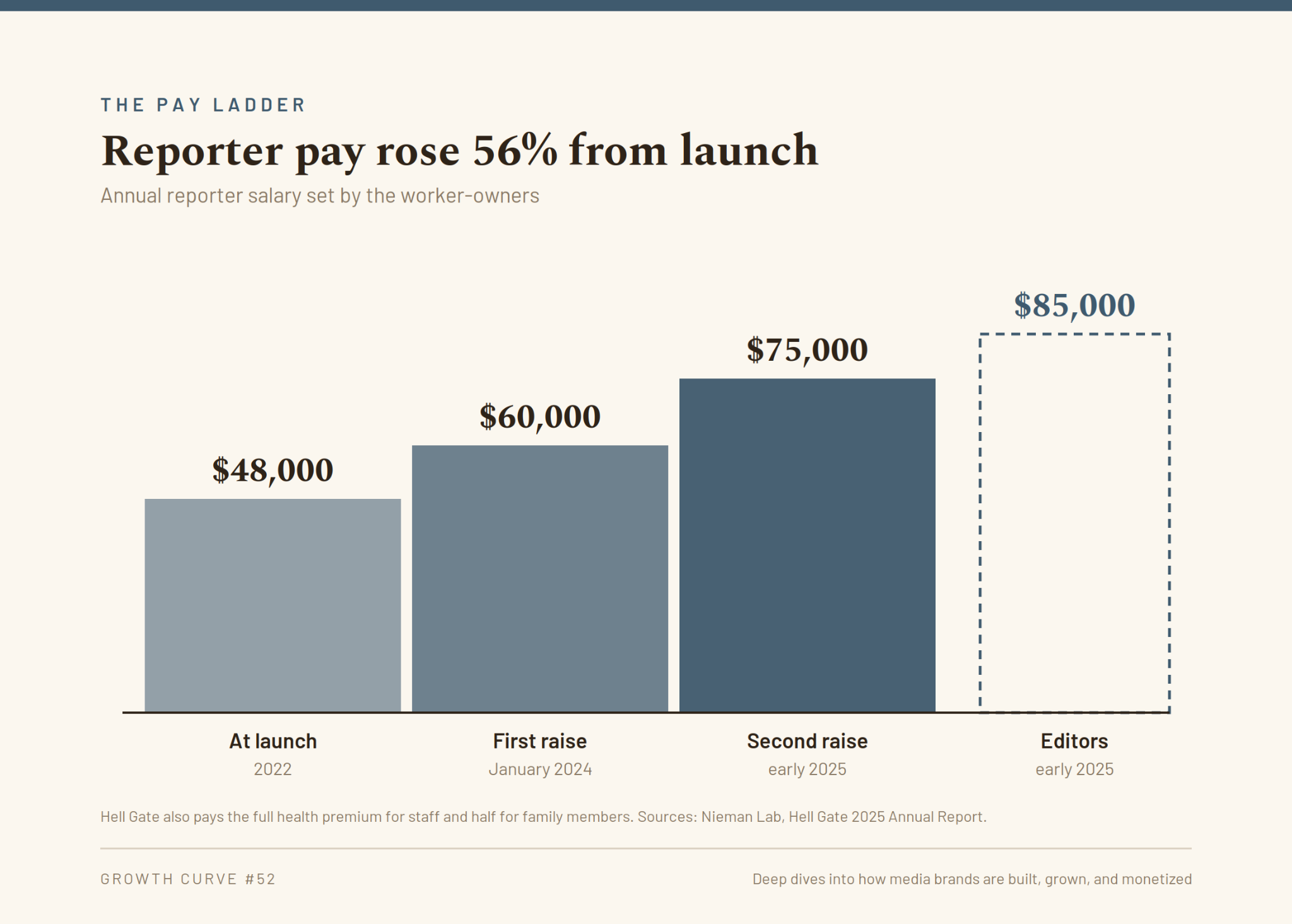
The speed a newsroom needs does not suit an extremely horizontal decision process, so two staffers work as editors with directing authority and higher pay. Salaries started at $48,000, rose to $60,000 in January 2024, and reached $75,000 for reporters and $85,000 for editors in early 2025. Hell Gate pays the full health insurance premium for staff and half the premium for family members, totaling about $4,170 per month in 2025.
Product Expansion
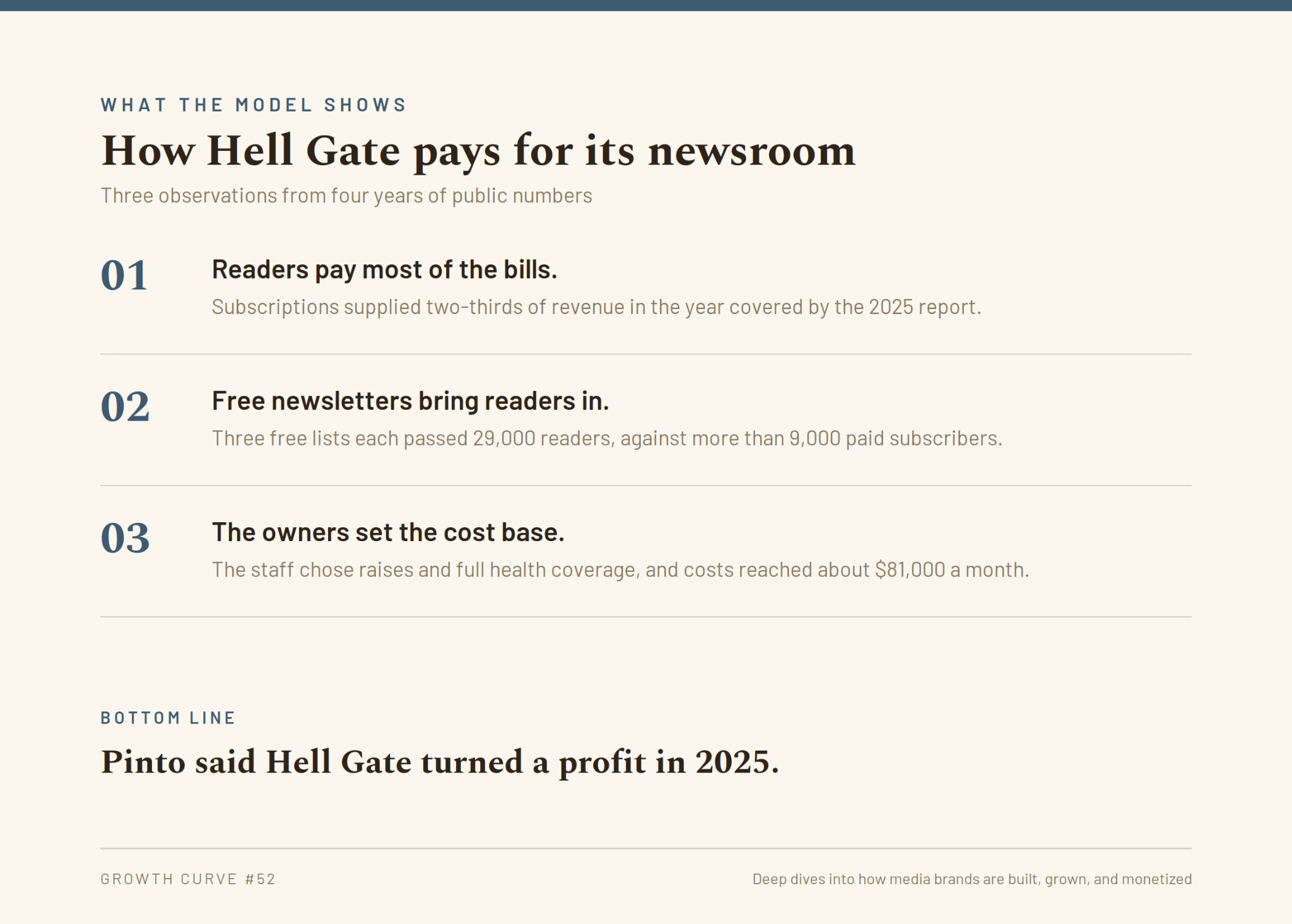
Hell Gate began as a paywalled website with a free newsletter. By September 2025, the twice-weekly Inbox Hell had 33,535 readers and the daily Morning Spew had 29,442. The Hell Gate Podcast launched in February 2023 and later became a weekly show, with producer Nic Nieves drawing in 3,000 to 4,000 downloads per episode. In 2025, Hell Gate turned Scott Lynch’s long-running $20 Dinner column into an interactive map for subscribers.
In July 2026, Hell Gate relaunched its website and newsletters with the worker-owned design firm Partner & Partners. The podcast moved to video and is recorded weekly at the Ruth Ann Harnisch studio in Lower Manhattan. The outlet also launched Cultural Capital, a biweekly newsletter on art, music, film, theater and television.
How Hell Gate Funds Its Newsroom
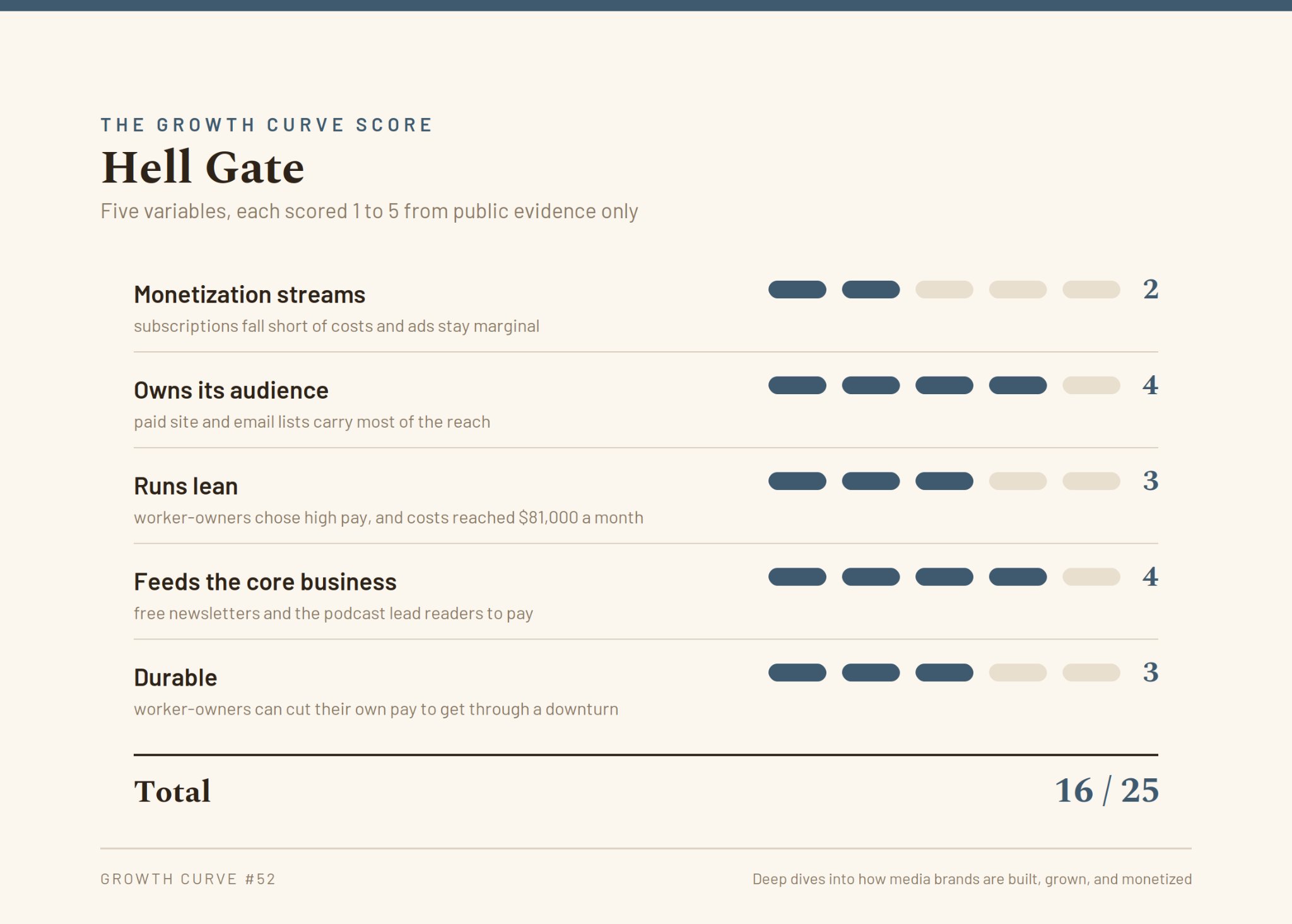
Subscriptions accounted for two-thirds of Hell Gate’s revenue in the year covered by its 2025 annual report. Donations from foundations and individuals provided most of the rest. Advertising brought in about $20,000 over twelve months, almost entirely through the newsletters. Advertisers included an off-Broadway play and a local cleaning service. The outlet also spent about $32,000 on union-made hats and beach towels for top-tier subscribers, plus $7,400 to mail them. A grant from Ruth Ann Harnisch will pay two years of rent for its office and podcast studio.
Local news is often thought of as a business that cannot support itself. Hell Gate’s founders expected slow growth in a crowded market with thin margins, and its annual report argues that advertising alone can no longer fund a city newsroom. The economics remain tight. Donations supplied about a third of revenue in the year covered by the 2025 report, while monthly costs rose roughly fourfold from launch as the team expanded and pay increased. Staff also handle business decisions alongside their reporting.
But subscription revenue has gained ground. In its 2024 report, monthly recurring revenue was about $17,000 below average monthly operating costs. In the 2025 report, that gap was about $11,000.
Hell Gate’s editorial voice gives readers a reason to choose it among many news outlets. Its journalist-owners decide what to cover, from City Hall investigations to restaurant guides and irreverent election reporting. That control extends to which advertisers the outlet accepts and how it spends its money. For media operators, the trade-off is between the time and effort required to run the business and the reporting that makes it distinctive. Despite all the challenges, Hell Gate turned a profit in 2025, doing so while paying reporters a respectable salary, covering their health insurance premiums, and keeping editorial decisions in-house.
Growth Curve Score
*** Every week, we pick apart how the world's best media brands got to where they are. This post is the long read. Growth Curve, our weekly newsletter, is the sharp version: same insight, shorter format, straight to your inbox. Subscribe free here. ***
Your newsletter won't build itself.