Newsletter Agency vs. In-House: How to Make the Right Decision for Your Business
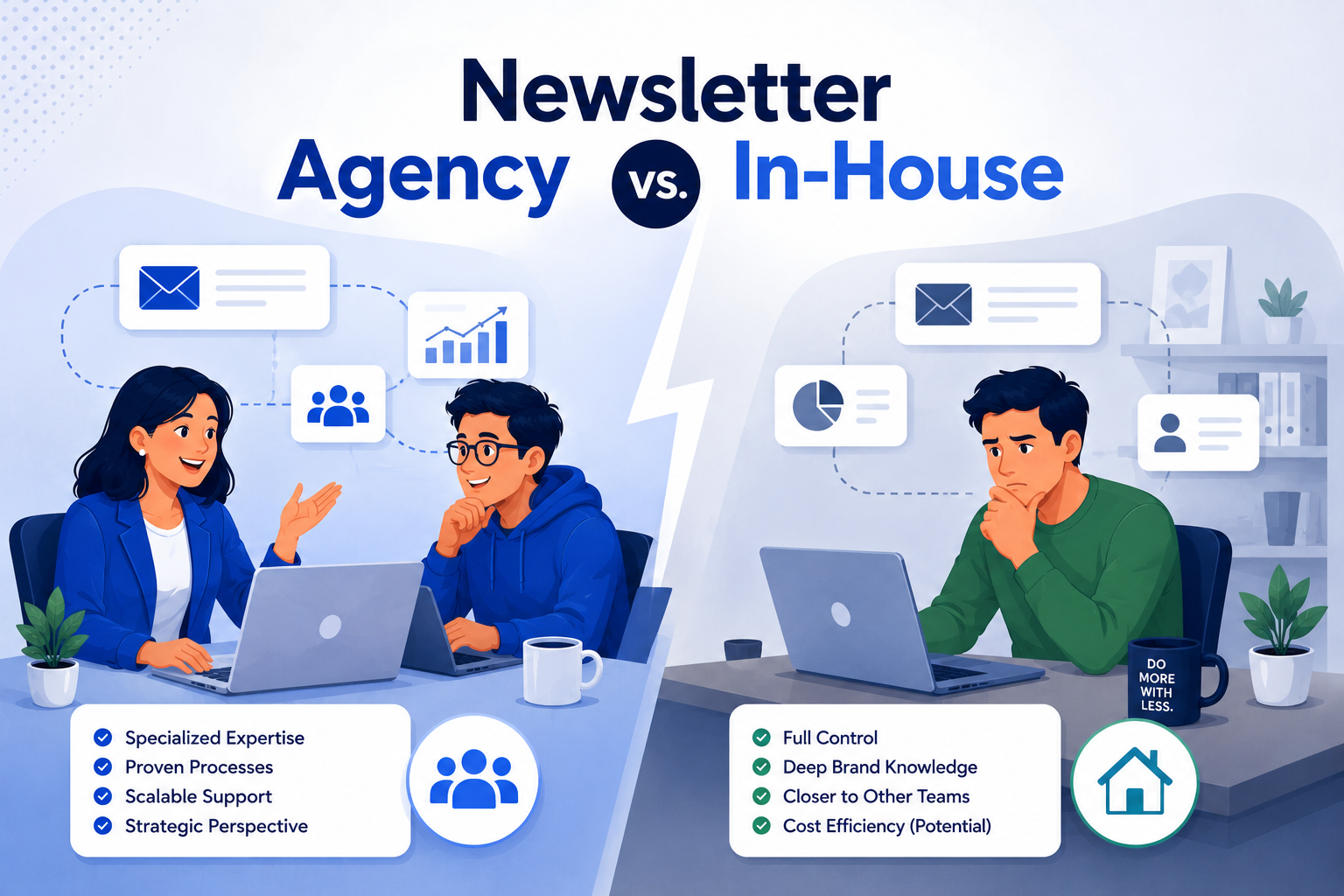

The question usually comes up in a marketing planning meeting or a quarterly review.
Someone suggests launching a newsletter. Maybe it's the second or third time it's been suggested a previous attempt stalled, or it keeps getting deprioritised. The question on the table: do we hire someone to own this internally, or do we bring in an agency?
Both options can work. Both can fail. The right answer depends entirely on your situation, not on which model is theoretically superior.
Here's the framework for making that decision clearly.
What "In-House" Actually Requires
In-house newsletter execution works when three things are true simultaneously. Most companies have one or two of them.
A dedicated owner: Not "someone who can work on it when they have time." A newsletter needs someone for whom it is a primary responsibility, not a side project. The newsletters that succeed in-house are the ones where a specific person's performance is measured partly by newsletter outcomes.
Writing capability: This one tends to be underestimated. Producing a newsletter that people actually read requires writing that has voice, clarity, and structure. Not everyone on a marketing team can produce that. If the person owning the newsletter can't write at that level, the newsletter will reflect it and readers will stop opening.
Audience development expertise: Writing a newsletter and growing one are different skills. Most in-house newsletter owners can produce content. Few have systematic experience growing a qualified B2B subscriber list. This is the gap that kills most in-house attempts not bad content, but a flat subscriber count that kills internal momentum.
If all three are present, in-house is probably the right answer. The people closest to your business, your customers, and your product will always have an advantage in authenticity and detail.
If one or more is missing, the calculus shifts.
What an Agency Actually Provides
An agency doesn't replace the need for internal involvement you'll still need to contribute subject matter expertise, review content, and be the strategic voice of the newsletter. What it does provide:
Content production at a consistent pace: The most common in-house failure mode is a newsletter that publishes four weeks in a row, then goes quiet for two weeks when something else takes priority. An agency's job is to make sure the newsletter ships, even when your quarter is on fire.
Audience development: Growth tactics: cross-promotions, lead magnet strategy, LinkedIn distribution, paid acquisition are where most agencies add their clearest value. Building an audience is harder and more systematic than most companies expect, and the experience of having done it for many clients matters.
Newsletter-specific expertise: Platform nuances, deliverability management, subject line testing, subscriber segmentation the operational layer of newsletter management has a learning curve. An agency brings it already traversed.
The Cost Comparison
In-house: a content marketer who can own a newsletter in a B2B company is a $65,000–$95,000 hire, plus benefits and management overhead. If you're hiring specifically for the newsletter, that's the cost.
Agency: B2B newsletter agency retainers typically run $4,000–$6,000/month depending on scope. At the upper end, that's $72,000 annually comparable to an in-house hire, with no employer costs and the flexibility to scale or exit.
The cost comparison isn't the deciding factor for most companies. The deciding factor is speed and risk.
An agency can be running in 30 days. An in-house hire takes 2–4 months to recruit, 1–2 months to onboard, and another 2–3 months to be genuinely effective. If you have a timeline attached to your newsletter goals, that gap matters.
Questions to Ask Before You Decide
Is there someone on your team who wants to own this? "Wants to" is important. A newsletter without an internal champion struggles regardless of who writes it. If someone on your team is genuinely excited about building this, in-house has a better chance. If it's being assigned to someone as an extra responsibility, outcomes are predictably mediocre.
What's your growth target and timeline? If you need 1,000 qualified subscribers in six months, an agency with audience development experience gets there faster than most in-house teams. If timeline is flexible and budget is tight, in-house with the right person is fine.
Have you tried in-house before? If you've attempted an in-house newsletter twice and it's stalled both times, the problem probably isn't the person it's the structural conditions in your company. An agency forces external accountability that most internal projects don't have.
A Third Option Worth Considering
The hybrid model: agency for launch and growth, transition to in-house once the newsletter has traction.
Launch with an agency for the first 6–12 months. Build the audience, establish the format, demonstrate the pipeline contribution. Then hire an internal newsletter editor who inherits a proven format and a growing list rather than starting from a blank page.
This approach reduces the risk of the in-house hire significantly (they're building on something rather than creating from scratch) and ensures the newsletter gets the systematic growth support it needs in the critical early period.
The Short Answer
If you have the right person, in-house is excellent. If you don't or if the newsletter has failed in-house before an agency will get you further, faster, for comparable cost.
The decision that produces the worst outcome, by a significant margin, is continuing to say "we should start a newsletter" in quarterly planning meetings without committing to either model.
The newsletter that generates pipeline is the one you actually build.
Your newsletter won't build itself.