The 2000s Blog That Keeps Finding New Monetization Models


*** Every week, we pick apart how the world's best media brands got to where they are. This post is the long read. Growth Curve, our weekly newsletter, is the sharp version: same insight, shorter format, straight to your inbox. Subscribe free here. ***
In 2003, Dave Portnoy began distributing a free four-page newspaper called Barstool Sports outside subway stations in Boston. It focused on gambling and fantasy sports and relied on an advertising model, with businesses paying for space while the paper remained free to readers. Barstool launched its website in 2007 and gradually expanded around a group of writers and personalities. Over the years, the company was sold to a private equity firm, acquired by a casino operator in two stages for more than half a billion dollars, and later sold back to Portnoy for $1. Across those ownership changes, Barstool continued to add new revenue streams.
A Media Brand Built Around Talent

Barstool's early print model influenced how the business developed. Portnoy was selling advertising to reach a specific audience of young men interested in sports and gambling, and the website extended that model with broader reach and lower distribution costs. By the early 2010s, Barstool had grown into a network of city-focused blogs built around individual writers and recurring personalities.
That structure turned out to be the company's durable asset. Traditional publishers usually build value around the publication itself, but Barstool also built individual personalities with audiences that followed them across different formats. The company then gave those personalities more ways to operate inside the Barstool ecosystem through podcasts, video shows, merchandise lines, live events, and sponsorships.
Writers could become podcasters, podcast audiences could support merchandise, and those larger personality-driven audiences could then attract sponsors. Over time, Barstool was effectively creating several smaller media brands within the company.
The $15 Million Bet on Barstool
In January 2016, The Chernin Group acquired a 51% stake in Barstool. Portnoy announced the deal in a press conference and put the total valuation at $10 to $15 million. The company moved from Boston to New York, and in July 2016 Chernin recruited Erika Nardini, previously chief marketing officer at AOL, as chief executive. Nardini, who now goes by Erika Ayers Badan, ran the company for the next 7.5 years.
Under Chernin, Barstool became a mature media business. In March 2016, Barstool launched Pardon My Take, a comedy sports podcast hosted by Dan Katz, with PFT Commenter, that became one of the most-downloaded sports podcasts in the country. Merchandise grew from novelty T-shirts into a core revenue line with constant limited drops tied to individual personalities and running jokes. The company acquired the amateur boxing promotion Rough N Rowdy in November 2016 and turned it into a pay-per-view events business. In January 2018, Chernin invested another $15 million at a valuation above $100 million, bringing its total investment to $25 million, according to Bloomberg.
The model also created reputational risk. ESPN launched a Barstool television show in October 2017 but canceled it after one episode after past misogynistic comments by Portnoy resurfaced. Several advertisers also chose to distance themselves from the brand at different points in time. Even so, Barstool’s audience continued to grow, helped by the fact that many readers and listeners followed specific personalities.
When Barstool Became a Gambling Distribution Engine
In January 2020, Penn National Gaming announced the purchase of a 36% stake in Barstool. Penn's 10-K recorded the purchase price as $161.2 million, consisting of $135.0 million in cash and $23.1 million in Penn preferred stock. The deal valued Barstool at a reported $450 million. Recode reported that Barstool generated between $90 million and $100 million in revenue in 2019, earned primarily from podcasts, merchandise, and gambling content.
The casino operator received the exclusive right to use the Barstool brand for its online and retail sports betting products for up to 40 years, and it rebranded its sportsbook app as Barstool Sportsbook. The thesis was that Barstool's audience of young sports gamblers would download the app on the strength of the brand alone, sparing Penn the promotional spending that competitors like DraftKings and FanDuel deployed at enormous scale.
In February 2023, when Penn exercised its rights to acquire the remaining 64% for approximately $388 million, the company's announcement cited audience growth of 194% since the 2020 investment, 1.6 billion podcast downloads, 128 billion video views, and more than 5 million units of merchandise sold. CNBC reported that the transaction valued Barstool at $606 million.
Barstool Comes Home for a Dollar
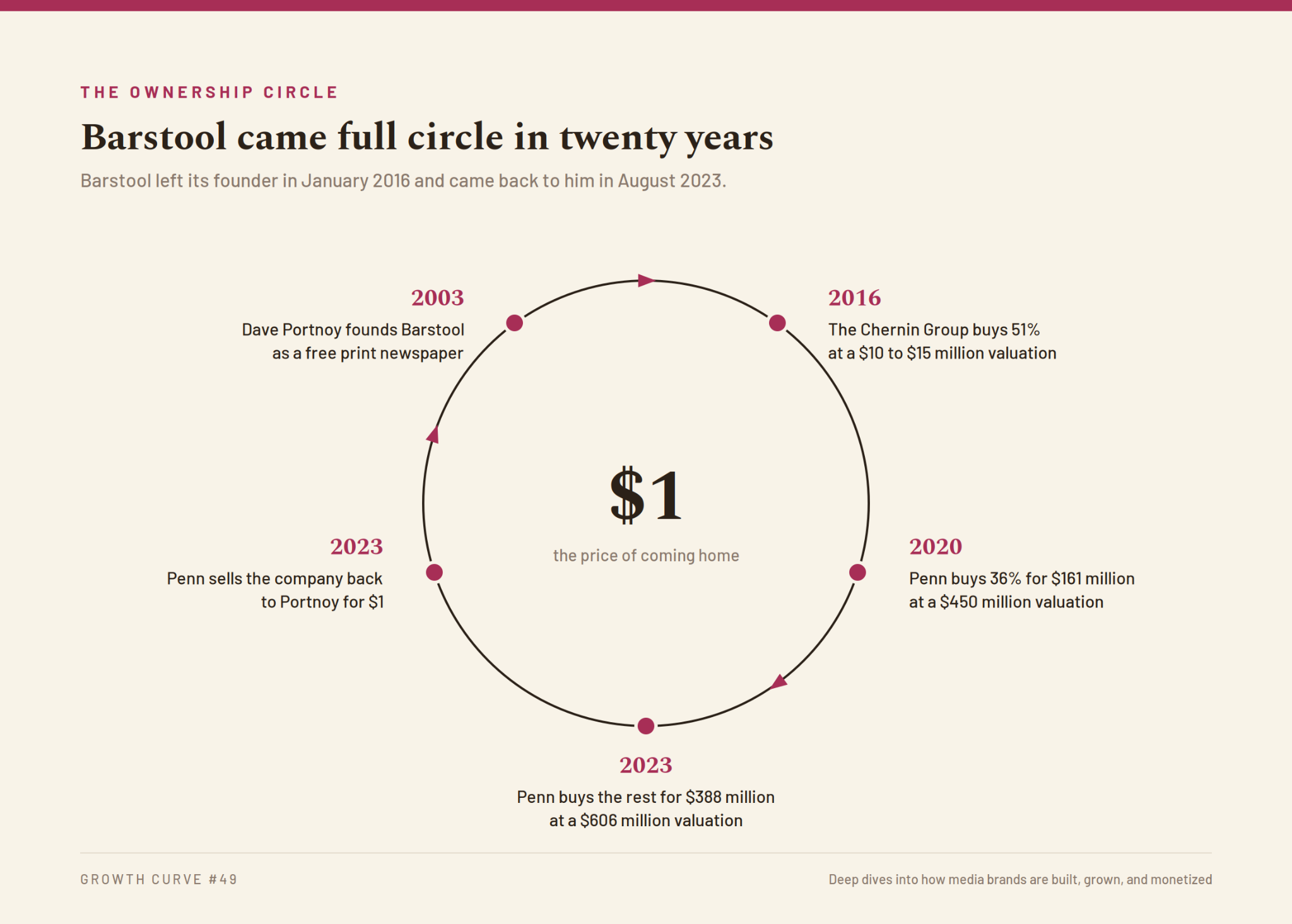
The full ownership lasted just under six months. Barstool posted a $16 million loss for the first half of 2023, per Sportico, while Barstool’s history of controversies created additional regulatory complications for Penn as it pursued and maintained gaming licenses across multiple states. On August 8, 2023, Penn announced a ten-year, $1.5 billion licensing deal with ESPN to rebrand its sportsbook as ESPN Bet. On the same day, Penn disclosed that it had sold 100% of Barstool's shares back to Portnoy in exchange for $1, non-compete covenants, and the right to receive 50% of the gross proceeds from any future sale or monetization of the company. Penn recorded a pre-tax non-cash loss of $800 to $850 million on the disposal. On the earnings call, chief executive Jay Snowden told analysts that a publicly traded, highly regulated gaming company had proven to be an unnatural owner for Barstool.
Portnoy said after the deal that he did not plan to sell the company again. The restrictions tied to the sale were also narrower than initially understood. Sportico reported that the betting-related non-compete expired at the end of the 2023 football season, and by January 2024, Barstool was in advanced discussions with DraftKings over a marketing deal reportedly worth a low eight-figure amount annually. Under the proposed arrangement, Barstool would feature DraftKings odds and direct users to the platform. Within months of returning to independent ownership, gambling-related revenue was back.
Independent Again, With More Ways to Monetize
Ayers Badan departed in January 2024 to become chief executive of Food52, and Portnoy resumed direct control of the company. In July 2025, Fox Sports announced a wide-ranging collaboration under which Portnoy joined Big Noon Kickoff as a regular contributor. Barstool personalities, including Katz, appear across Fox's college coverage. The Barstool College Football Show airs on Fox digital platforms and Tubi, and Barstool produces a live 2-hour weekday studio show for FS1. The arrangement gave Barstool sustained national television distribution for the first time in its two-decade history.
Barstool's Durable Business Model

Barstool is once again privately owned by Dave Portnoy, with revenue coming from advertising and podcast sponsorships, merchandise, live events, sports-betting partnerships, and distribution deals with other media brands. Barstool’s next phase appears to center on licensing its shows, personalities, and audience to larger platforms.
Since returning to independent ownership, it has signed a multi-year DraftKings marketing partnership reportedly worth a low-eight-figure amount annually, while Netflix is paying an eight-figure annual sum for exclusive video rights to Pardon My Take, Spittin’ Chiclets, and The Ryen Russillo Podcast. Television adds another distribution channel. Barstool produces two hours of live programming for FS1 every weekday, or roughly ten hours a week, alongside appearances across Fox’s college football and basketball coverage.
Barstool no longer needs to own a sportsbook or build a television network to participate in those markets. It can create the personalities and programming, keep the underlying audience, and charge larger companies for distribution, sponsorship, and access. For media operators, the lesson is that audience ownership becomes more valuable when it can support several products at once. Barstool did not rely on a single format, platform, or advertiser category. It repeatedly turned the same personalities and audiences into podcasts, merchandise, sponsorships, events, betting partnerships, and television distribution.

*** Every week, we pick apart how the world's best media brands got to where they are. This post is the long read. Growth Curve, our weekly newsletter, is the sharp version: same insight, shorter format, straight to your inbox. Subscribe free here. ***
Your newsletter won't build itself.

The 2000s Blog That Keeps Finding New Monetization Models
How Deadspin's Former Staff Built a Worker-Owned Media Company Without Outside Investors
Inside Puck’s Bet on Writer Ownership