Newsletter Automation Workflows for B2B: Welcome Sequences, Re-Engagement, and More
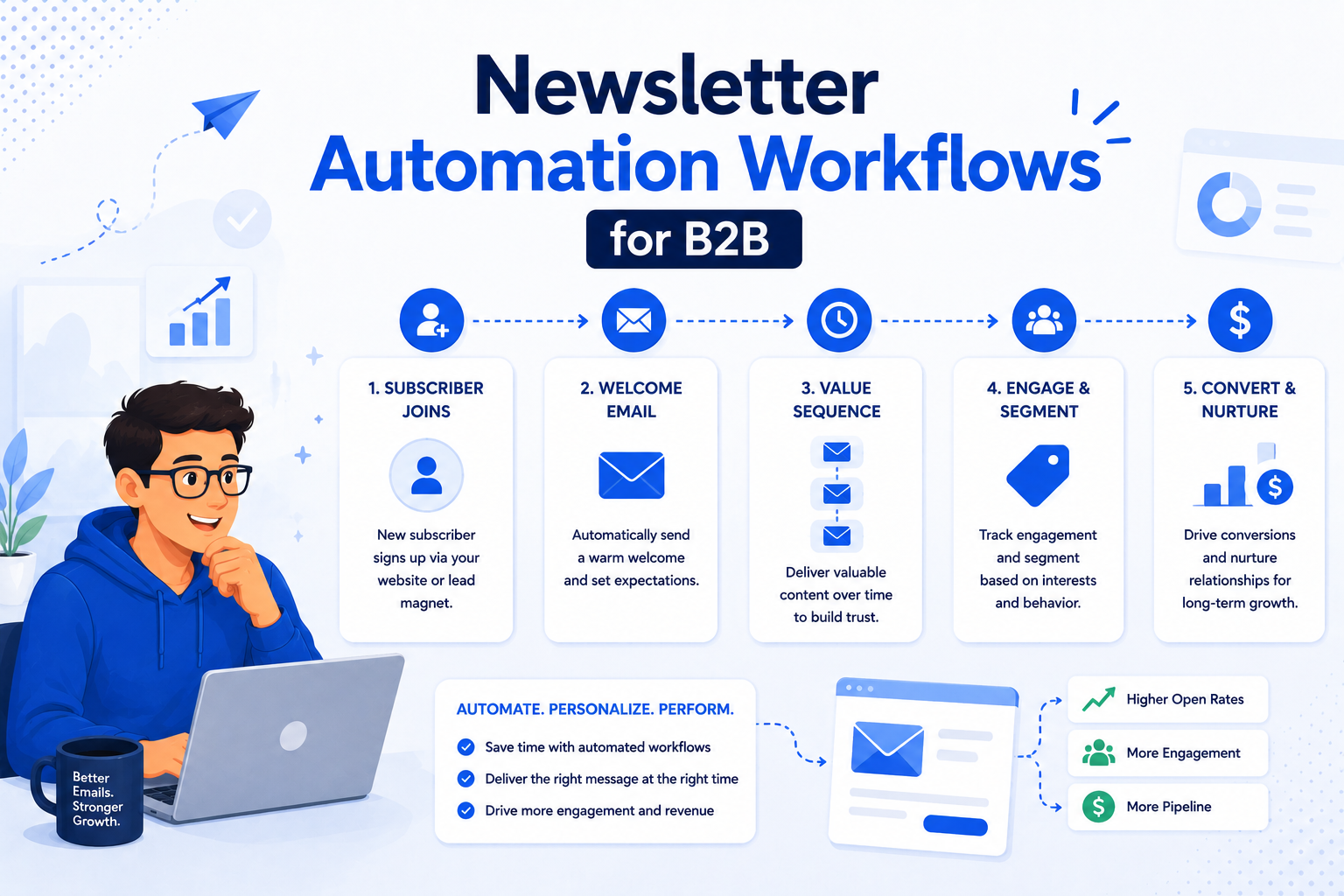

Most B2B newsletters treat all subscribers the same.
New subscriber who just signed up three days ago? Same email as the subscriber who's been reading for eight months. Someone who hasn't opened in 90 days? Same content as someone who opens and replies every week.
Automation changes this. A small set of targeted workflows, none of them complicated can significantly improve engagement, reduce churn, and surface more sales conversations from the same subscriber list.
Here are the four workflows worth building, in priority order.
Workflow 1: The Welcome Sequence
Purpose: Set expectations, deliver immediate value, establish the habit of reading.
This is the most important automation in your newsletter stack. The subscribers most likely to become long-term readers -- and eventually, customers are the ones who engage in the first two weeks. The welcome sequence is your mechanism for making that happen.
A strong B2B newsletter welcome sequence has three emails:
Email 1 (immediately on subscribe): Deliver the lead magnet if you have one. Introduce the newsletter: who it's for, what they'll get, how often it arrives. Set one expectation: "every Tuesday at 8am, you'll get X." Keep it short.
Email 2 (day 3): Your best-performing past issue, framed as "in case you missed it." Don't ask them to do anything just give them your best content. This is the issue that made your most engaged current subscribers stay. Use it to make the same case to new arrivals.
Email 3 (day 7): A soft CTA. Ask them a direct question: "What's your biggest challenge with X right now?" This single email generates more reply conversations than most newsletters get in a month. Someone who replies is a warm lead. Treat it that way.
One important note: the three-email sequence described above is specifically for confirming engagement before a subscriber reaches your main list. Only subscribers who open at least one of these three emails should proceed to your regular newsletter cadence. This protects your deliverability and ensures your main list stays engaged. It's a practice we apply across all our client accounts.
Workflow 2: The Re-Engagement Sequence
Purpose: Win back inactive subscribers before removing them.
A subscriber who hasn't opened your newsletter in 90 days is hurting your deliverability. Email platforms use engagement signals to decide whether your emails go to the inbox or the spam folder. Inactive subscribers drag those signals down for everyone.
The re-engagement sequence runs automatically when a subscriber crosses the 90-day inactive threshold:
Email 1: "We noticed you haven't been around lately." Acknowledge the gap directly. Send your highest-ever-performing issue. Minimal copy, maximum content.
Email 2 (5 days later if no open): A direct, honest message. "Should we keep sending? We want to make sure we're still useful to you. Click here if you'd like to stay subscribed." This is called a "confirm your subscription" email, it feels counterintuitive to ask subscribers to reconfirm, but it generates a decision, which is what you need.
If no response: Remove them from the list. A smaller, engaged list performs better than a larger, inactive one in every metric that matters.
Workflow 3: The Lead Nurture Sequence
Purpose: Move high-intent subscribers toward a sales conversation.
Most newsletters have no mechanism for identifying when a subscriber is showing buying signals. They just get the same weekly newsletter as everyone else.
A lead nurture sequence changes this. Trigger it when a subscriber takes a high-intent action clicking a pricing page link, visiting the services page on your website, or downloading a specific resource.
Email 1 (triggered by action): Relevant content directly related to what they clicked. If they visited your pricing page, send a case study of a company at a similar stage that worked with you. Don't reference the tracking just send something useful.
Email 2 (3 days later): A soft CTA: "If you're thinking about X, I'm happy to spend 20 minutes walking through what it's looked like for similar companies. No pitch. Just context."
This workflow won't produce a flood of leads. It will produce a small number of very warm ones, people who've already demonstrated interest and are one conversation away from moving forward.
Workflow 4: The Milestone Sequence
Purpose: Turn long-term subscribers into referrers and advocates.
A subscriber who has been on your list for six months is one of your most valuable assets. They've chosen, repeatedly, to keep reading. They're likely engaged with your content and your brand in ways that newer subscribers aren't.
A milestone sequence acknowledges this and activates it:
6-month milestone email: "You've been reading for six months; thank you." Share a piece of exclusive content: a resource, a framework, or an insight that isn't published anywhere else. This rewards loyalty and reinforces the behaviour you want (staying subscribed, staying engaged).
Referral activation: Include your referral programme link in the milestone email. Six-month subscribers are your warmest potential referrers they know what the newsletter is, they've had time to see its value, and they're likely to know others in your ICP.
The Technical Setup
All four of these workflows are available in Beehiiv's automation suite without requiring additional tools. If you're on another platform, most major email providers support equivalent functionality -Mailchimp, ActiveCampaign, and ConvertKit all support trigger-based sequences.
The setup investment is front-loaded. Building the welcome sequence takes a few hours. Once it's running, it works without further input. Every new subscriber moves through it automatically.
The return on that few hours of setup is compounding. Every subscriber who arrives from this point forward gets a better first experience than they would have otherwise. That adds up across hundreds of subscribers over months and years.
If you're going to do one thing from this guide, do the welcome sequence. It's the highest-impact automation available to any newsletter and the one most B2B companies don't have.
Your newsletter won't build itself.

What Is a B2B Newsletter? (And How It's Different From a Consumer One)
Newsletter Consultant vs. Newsletter Agency: Which One Actually Moves the Needle?
What Is a B2B Newsletter Agency (And What They Actually Do)