How a French Tire Company Built the Most Valuable Media Brand in Fine Dining


*** Every week, we pick apart how the world's best media brands got to where they are. This post is the long read. Growth Curve, our weekly newsletter, is the sharp version: same insight, shorter format, straight to your inbox. Subscribe free here. ***
------------
In 1900, two brothers running a small tire factory in Clermont-Ferrand published a free 399-page booklet for the fewer than 3,000 motorists in France. The book listed petrol pharmacies, mechanics, hotels, and a few restaurants attached to hotels. The first print run was 35,000 copies, and it cost the reader nothing. The brothers were André and Édouard Michelin, and the booklet existed for a single reason: if French drivers had a reason to drive farther, they would wear out their tires faster, and Michelin would sell more tires.
A century later, the same publication decides which restaurants in 43 countries become destinations and which fade. Chefs cry on television when they lose a star. National tourism boards pay seven figures to be considered for inclusion. The Michelin Guide is the most enduring example in modern business of content marketing that outgrew the product it was built to sell, and the playbook behind it is still useful for any operator trying to build durable demand without buying it.
The Long Free Period
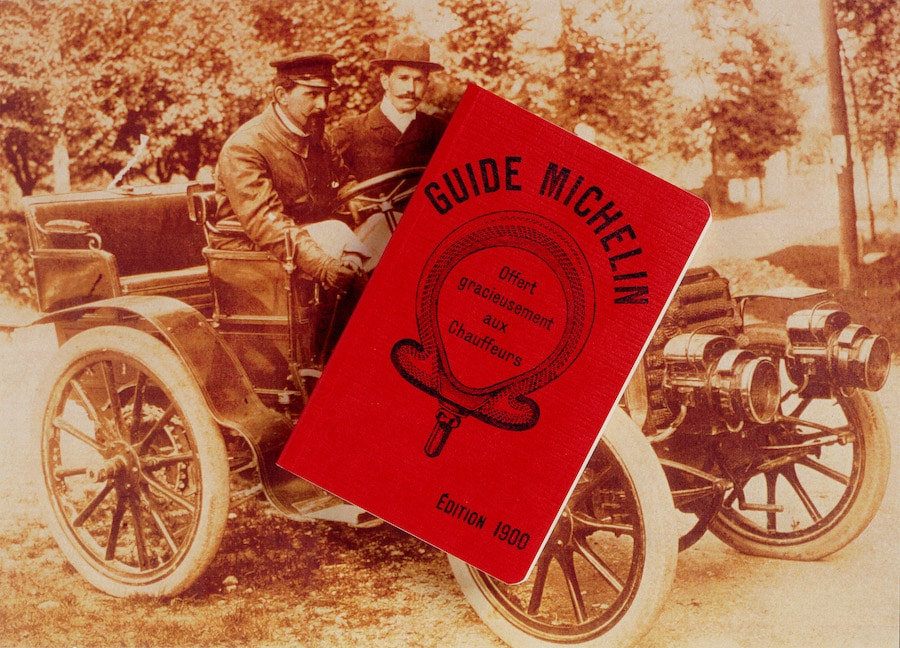
Michelin gave the guide away for twenty years. Forty thousand copies in 1900, country editions in Belgium by 1904, the United Kingdom by 1911, and distribution across Europe before the First World War halted production. The economics were simple. The cost of printing a guidebook was a fraction of the marginal revenue from a single additional tire sale, so the guide could be loss-leading indefinitely as long as it drove sales.
What the free period bought Michelin was not awareness. Awareness was cheap. What it bought was a habit. By 1920, asking a French driver to plan a trip without consulting a Michelin Guide was like asking them to plan it without consulting a map. The guide became the default reference for an entire generation of motorists, and that default status is what made the next twenty years possible.
The story most often told about 1920 is that André Michelin walked into a garage and found his guide propping up a workbench. He decided that man only truly respects what he pays for and began charging seven francs per copy. The 1920 edition dropped paid advertising, added Paris hotels organized by category, and introduced something the guide had not had before. Michelin hired full-time employees whose job was to eat at restaurants without identifying themselves, file detailed reports, and revisit on different days at different meal times. The inspectors were instructed not to disclose their work to friends, family, or journalists. That secrecy is still Michelin’s policy today.
A free travel pamphlet with listings is a directory. A paid publication with full-time anonymous reviewers is a credentialing body. By 1926, Michelin had begun awarding a single star to restaurants of distinction. In 1931, the hierarchy expanded to one-, two-, and three-star ratings, and in 1936, Michelin published the criteria. One star meant a very good restaurant in its category. Two meant excellent cooking, worth a detour. Three meant exceptional cuisine, worth a special journey.
The Inverted Pyramid
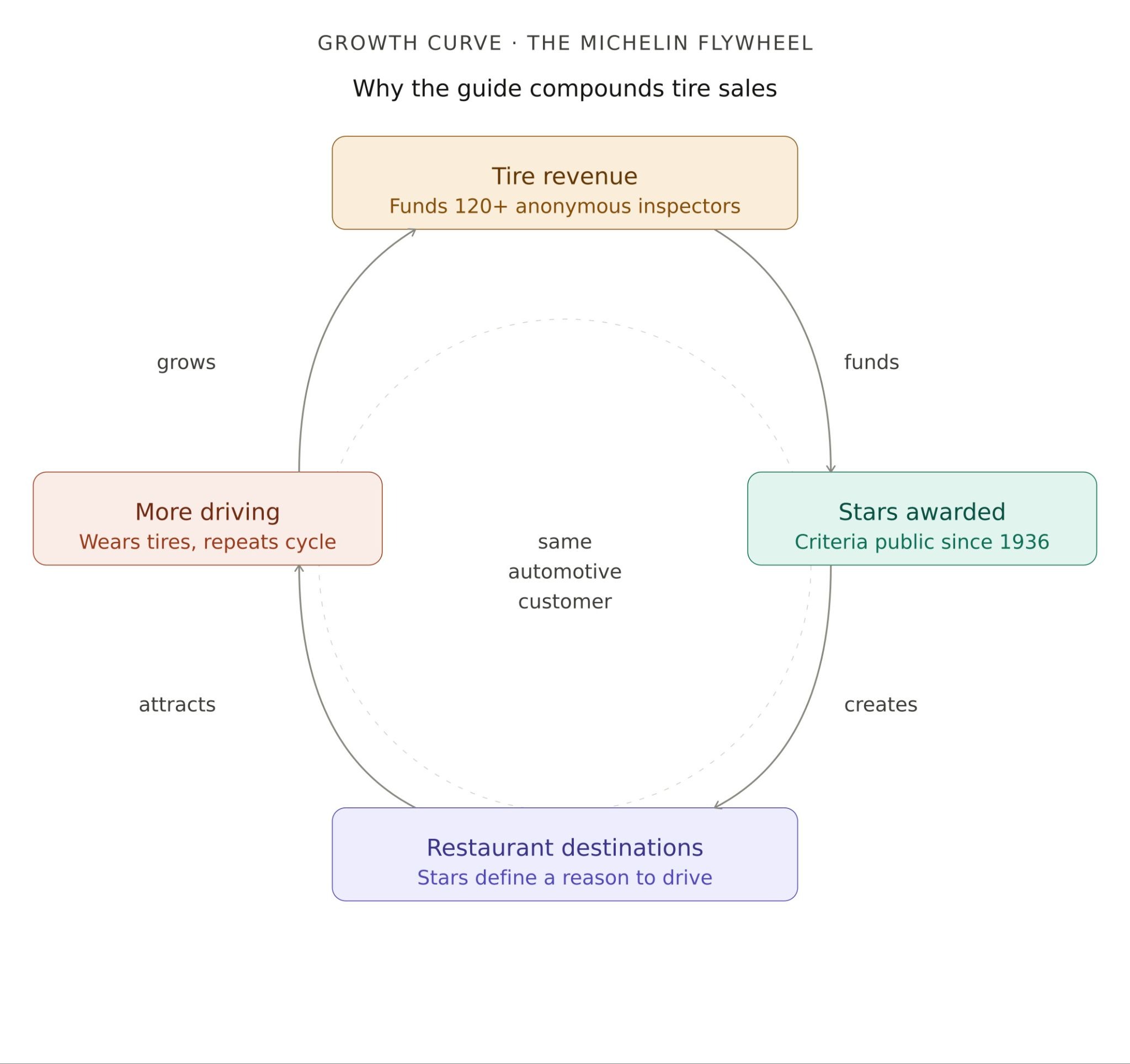
Most content marketing operations are organized to push readers toward a transaction. The reader consumes the content, develops trust, and eventually buys the underlying product. Michelin inverted that structure. A driver buys a Michelin tire because their car needs one. The guide arrives afterward, increasing the tire's value by giving its owner reasons to use it. Every restaurant in the guide is a downstream demand-generation asset.
This is why the guide could sustain such an expensive editorial operation for so long. Michelin was not trying to convert readers into customers. It was trying to keep existing customers driving. The lifetime value of a tire buyer who replaces tires every four years is meaningfully higher than that of one who replaces them every six, and the marginal cost of running an inspector network is small relative to that delta when amortized across millions of customers.
Critics have long noted that Michelin appears to lose money on the guide as a standalone unit. That is the wrong frame. The guide was never designed to be a standalone unit. It is a retention mechanism for the tire business, and judged on that metric, it has worked for 125 years.
The Sustainability of the Format
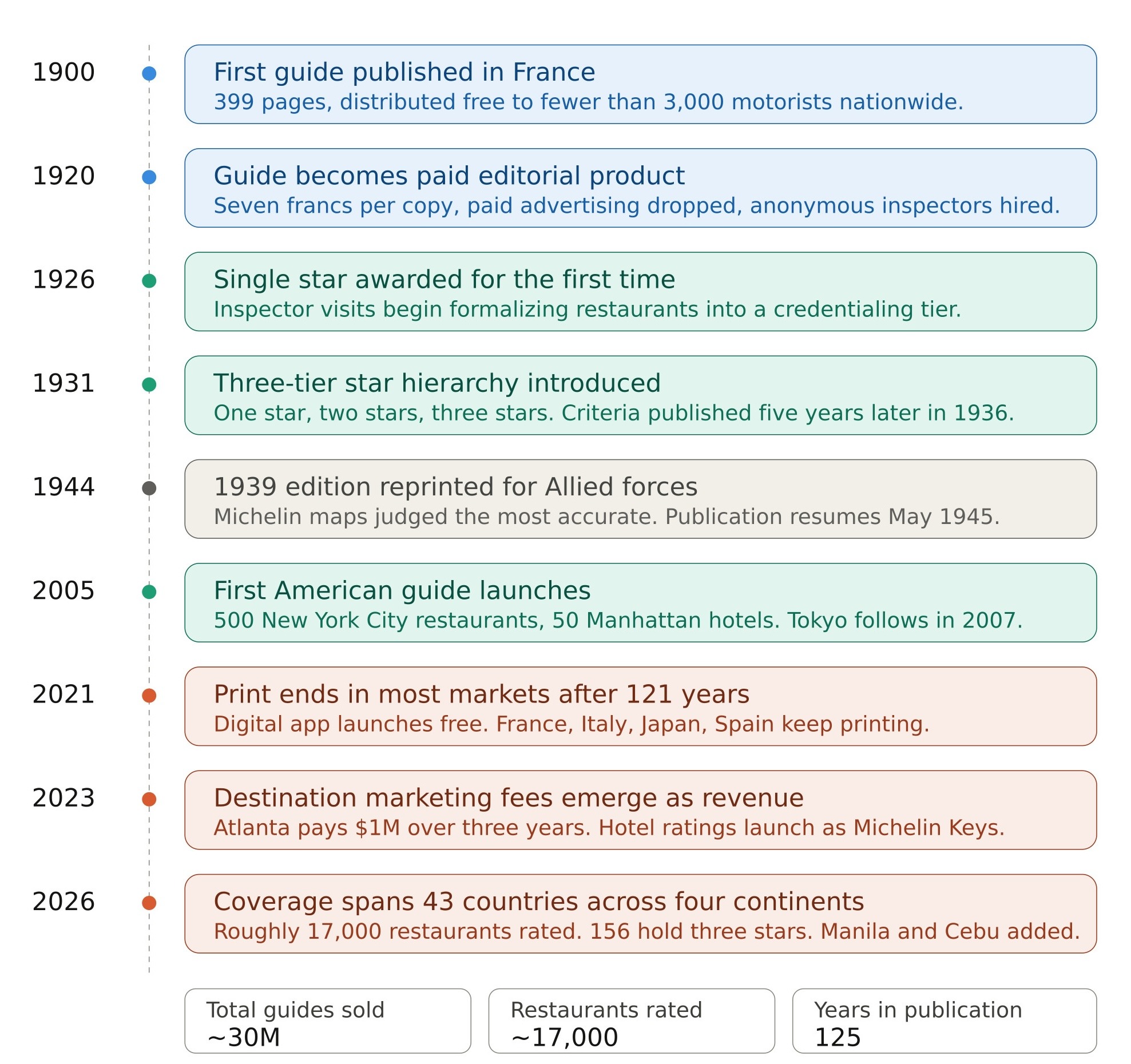
The guide survived the Second World War because the Allies asked Michelin to reprint the 1939 French edition for military use in 1944. The maps were judged the most accurate available, and copies were distributed to forces landing in Normandy. After the war, the guide returned in May 1945 with the same structure and the same star system, and it continued to expand. The first Italian edition came in 1956. The first American edition, covering 500 restaurants in New York City, came out in 2005. Tokyo followed in 2007, Hong Kong and Macau in 2008.
Each new market followed the same logic. Michelin entered cities where its tire business already operated or where automotive tourism was growing, and the guide gave drivers and travelers a reason to engage with the brand outside the moment of tire purchase. Today, the guide covers around 43 countries and rates roughly 17,000 restaurants, with about 3,700 holding stars across one, two, and three tiers, including around 156 at three stars.
In 2021, after 121 consecutive years of print publication, Michelin ended printed editions in most markets and moved the guide to a free digital app. France, Italy, Japan, and Spain still receive print runs. The current model has three streams that the early guide did not. Destination marketing fees, in which tourism boards and city governments pay Michelin to evaluate their regions, with Atlanta reportedly paying around $1 million over three years and Colorado cities paying between $70,000 and $100,000 each to be considered. Hotel ratings, introduced in October 2023 under a separate Michelin Keys system that follows the same star logic for accommodations. And data and services for fleet operators, which is the part of Michelin most directly tied to the original tire business.
The destination marketing arrangement has drawn criticism, since paying for inclusion sits uneasily with the guide's reputation for editorial independence. Michelin's position is that payment buys consideration, not stars, and that inspectors retain anonymity and discretion in the evaluation. Whether that distinction holds long-term is one of the open questions about the brand.
What the Guide Actually Sells
A first star measurably increases reservation demand, raises average check size, lifts staff retention, and changes which suppliers and landlords are willing to work with the restaurant. A second star compounds the effect. A third star, of which there are roughly 156 worldwide, places the restaurant in a category small enough that international travelers will book a flight specifically to dine there.
Michelin does not charge the restaurant for any of this. The star is given, not sold, and refusing a star is the only formal mechanism a restaurant has to opt out, which a handful of chefs have done over the years for reasons ranging from operational stress to philosophical disagreement. Restaurants do not pay Michelin, but they reorganize their entire operation around what Michelin might do. That kind of leverage over an industry is something most content businesses spend decades trying to build and never achieve.
Three structural decisions explain why the Michelin Guide became dominant rather than just popular.
1. The first was treating the guide as aligned to the core business rather than as a separate business. This kept editorial discipline intact, since the guide did not need to chase short-term reader revenue or advertiser approval, and it gave Michelin the patience that competitors could not match.
2. The second was investing in evaluation rigor early. The anonymous inspector system was expensive in 1920 and remains so now, with current estimates suggesting Michelin employs more than 120 full-time inspectors globally who travel three weeks a month and dine out as many as 10 times a week. Most content brands cannot justify this kind of cost structure because their content is the product. For Michelin, the content was always the marketing, which meant the budget could be sized against tire revenue rather than guide revenue.
3. The third was the geographic restraint. Michelin did not expand the guide to every market at once. New countries were added slowly, often decades after the tire business established a local presence. This kept the credentialing scarce, which kept the stars valuable, which kept the guide influential.
What This Looks Like for Operators
Most B2B and consumer brands today are trying to solve the awareness problem with content, which is why most content marketing operations look the same and produce roughly similar results. The brands that build durable advantages are usually the ones doing what Michelin did. Finding a structural reason their existing customers underuse the product, then building editorial that removes that bottleneck, and treating the resulting content not as a marketing line item but as an asset that compounds in value alongside the core business it serves.
The Michelin Guide has been doing that for 125 years. Almost nothing else in modern marketing has lasted that long, and almost nothing else has built that much leverage over the industry it serves.
-------
*** Every week, we pick apart how the world's best media brands got to where they are. This post is the long read. Growth Curve, our weekly newsletter, is the sharp version: same insight, shorter format, straight to your inbox. Subscribe free here. ***
Your newsletter won't build itself.


The 2000s Blog That Keeps Finding New Monetization Models
How Deadspin's Former Staff Built a Worker-Owned Media Company Without Outside Investors
Inside Puck’s Bet on Writer Ownership