How a Plain Daily Newsletter Reached 4.6 Million Readers

*** Every week, we pick apart how the world's best media brands got to where they are. This post is the long read. Growth Curve, our weekly newsletter, is the sharp version: same insight, shorter format, straight to your inbox. Subscribe free here. ***
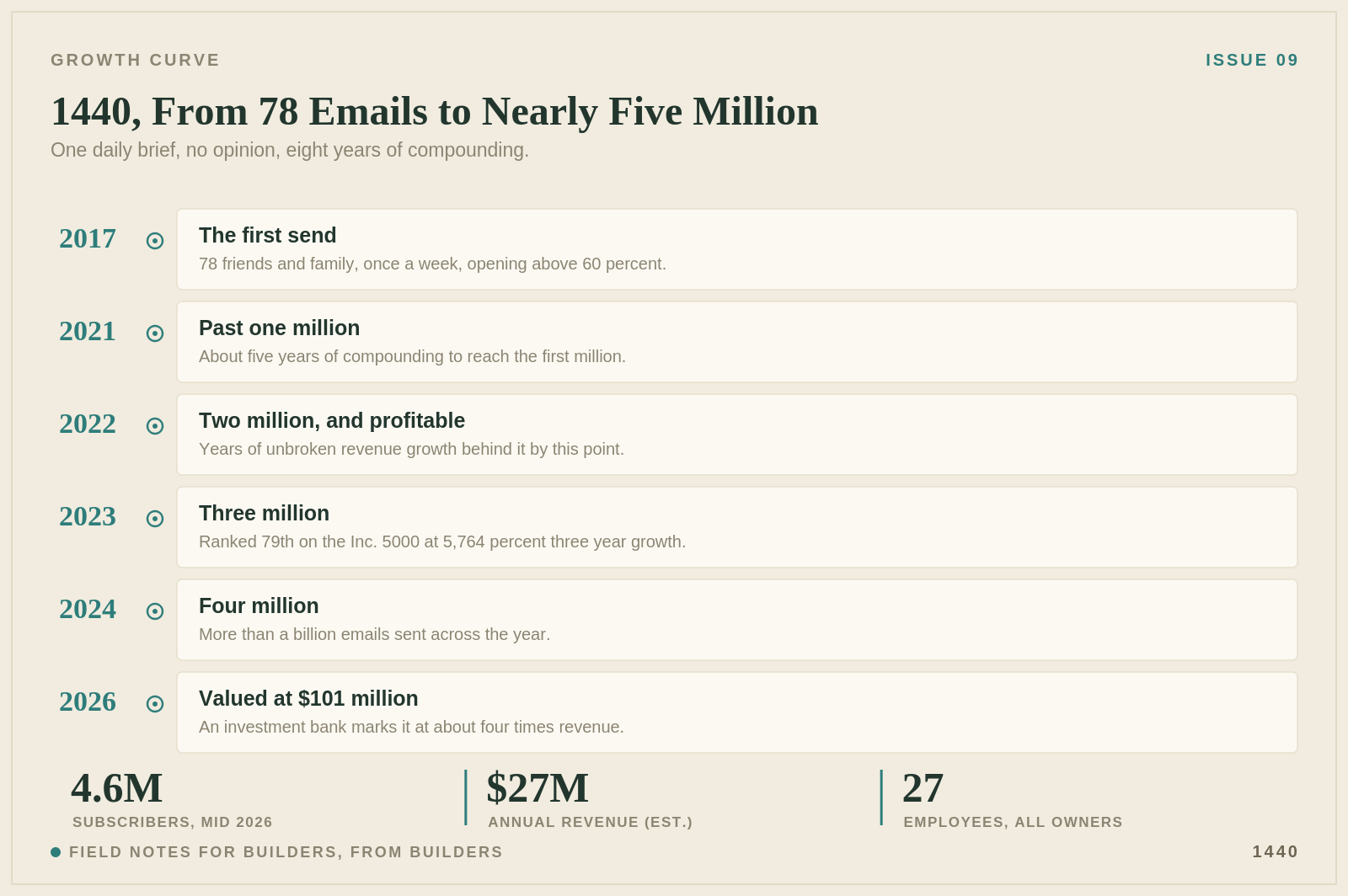
In 2017, Tim Huelskamp and Andrew Steigerwald sent the first version of their news summary to 78 friends and family. It arrived once a week to start, and the first send produced an open rate above 60%, with the small list growing from 78 to 91 by the next week.
Huelskamp had spent nearly a decade in private equity, much of it at a roughly $20 billion fund where he worked with underperforming companies. He had started in technology investment banking before that. When his firm was acquired, he took the severance as a runway for a startup. Steigerwald, his cofounder, holds a doctorate in interdisciplinary materials science and has spent years in technology and innovation policy, including a stint as a legislative fellow in the US Senate.
The two had met through a college football email chain full of academics, lawyers, and policy people, and they wanted a single publication that covered a little of everything and left explicit opinion out. The name 1440 refers to the number of minutes in a day and to the development of the printing press around 1440. The newsletter now reaches more than 4 million people, and a major investment bank has valued the company at $101 million.
The Founders Built the Newsletter They Wanted to Read
Huelskamp and Steigerwald started from two complaints about modern news. The first was specialization. A reader interested in technology subscribed to a tech newsletter, a politics reader went to a political outlet, and a finance reader went somewhere else. There was no source for the busy professional who wanted to know a little about everything without visiting a dozen sites. The second complaint was tone. Too much of the news arrived wrapped in ideological framing and performative outrage.
1440 scours hundreds of sources each day and produces a brief that takes about five minutes to read, running across politics, business, science, sports, and culture, written to inform while avoiding an explicit take. Steigerwald served as the editorial lead. In the early development, he kept his public policy job and woke at 4 a.m. for about two years to work on the newsletter while the list was still small.
A Flat Tone Created a Wider Market
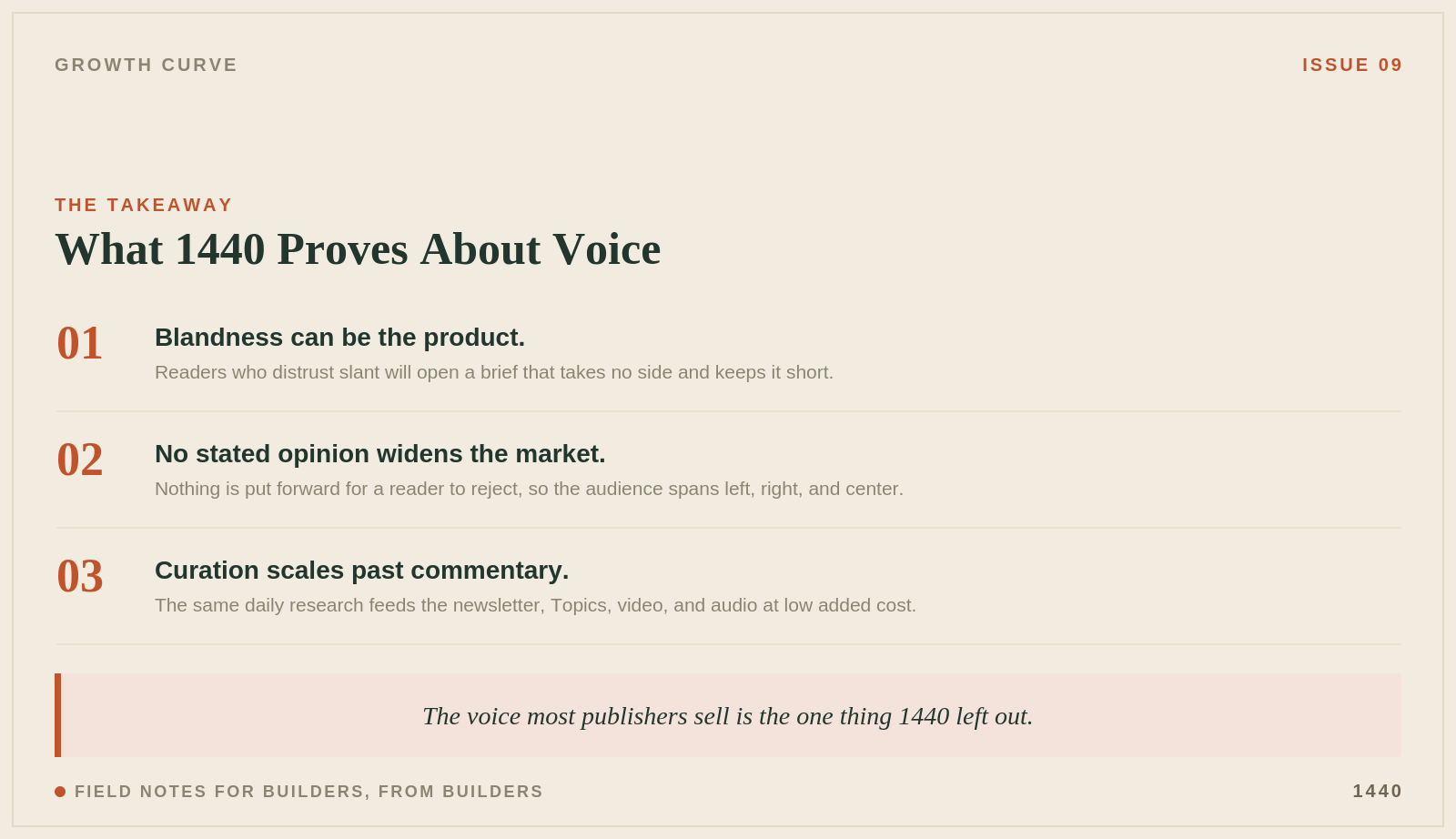
The flat, unopinionated tone was the product, and it served a specific reader. People who distrusted slanted coverage could open 1440 and get the day's facts without the editorializing they had come to resent elsewhere. The newsletter markets itself as delivering unbiased facts, citing the absence of emotional language and clickbait as reasons to subscribe. Choosing which stories to run and what context to add still involves editorial judgment, so the product was never neutral in an absolute sense, and Steigerwald has said as much about the curation. What 1440 did was keep overt commentary and partisan language to a minimum, which lowered the chance that a reader would quit over a stated political position. That widened the potential audience beyond any single group. Huelskamp has estimated the total market at roughly 100 million curious Americans.
Growth Ran on Unit Economics
Huelskamp ran the business the way he had once evaluated portfolio companies. The cost to acquire a subscriber had to remain below that subscriber's long-term value. His rule was to ignore paid acquisition until the product achieved a 45-50% open rate and clearly retained readers. Early on, the founders experimented across several channels, including Pinterest, Quora, and Reddit, before concentrating their spending on Facebook, Instagram, and Google, which offered the most scale. Readers acquired through other newsletters tended to open at about twice the rate of those from paid social, though they cost about twice as much and were harder to buy in volume. The company now spends a little under $1 million a month on acquisition and adds between 200,000 and 300,000 readers a month. About half stay, and roughly a third of all subscribers arrive organically. The growth compounded over a long curve. It took about five years to pass one million subscribers. The list crossed two million in October 2022, three million in November 2023, four million on October 17, 2024, and about 4.5 million in 2025. In 2023, the company ranked 79th on the Inc. 5000, with growth of 5,764% over three years.
Advertising Sold Against Predictable Reach
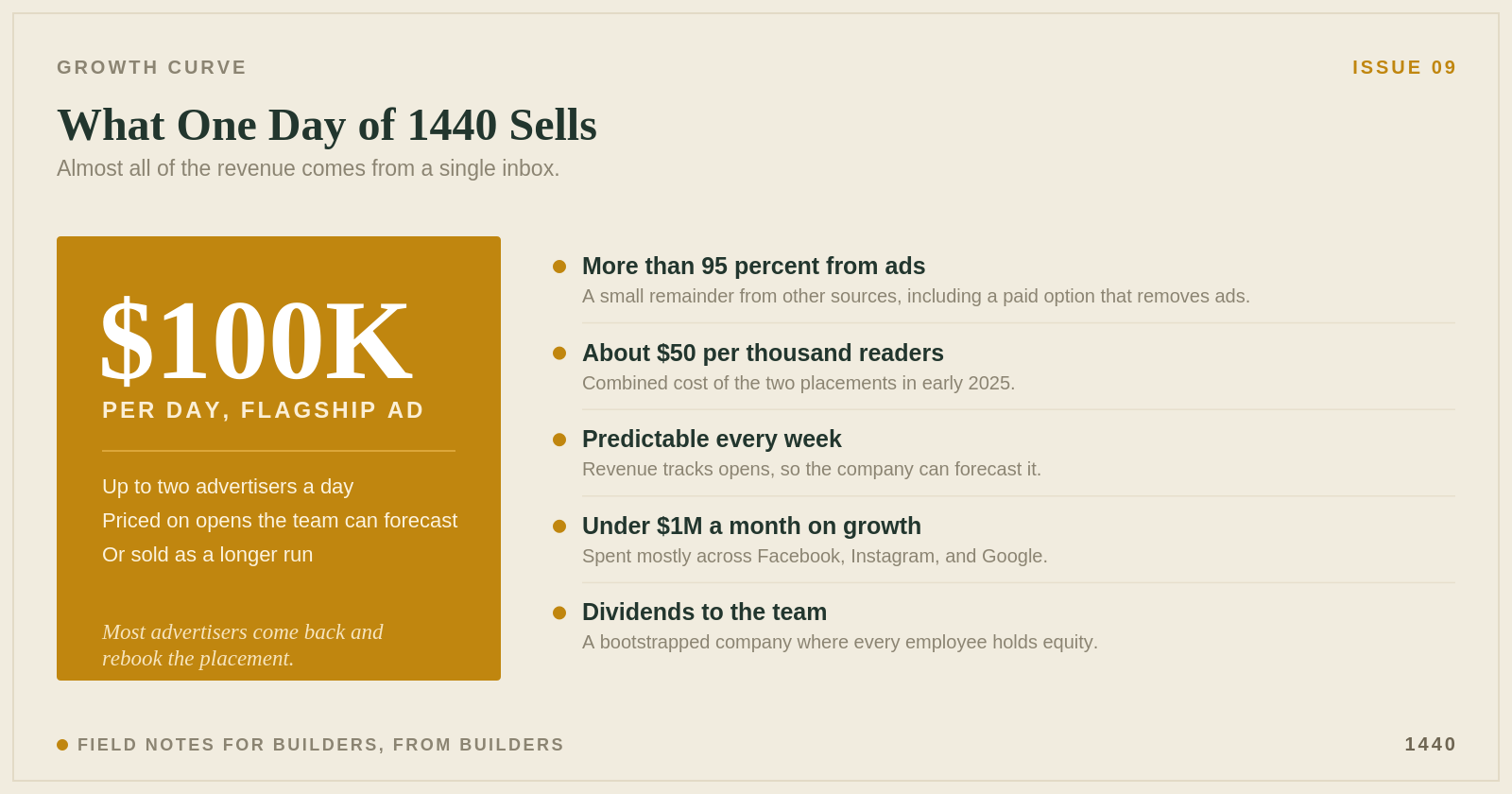
Nearly all of 1440's revenue comes from advertising, with a small remainder from other sources, including a paid option that removes ads. The newsletter runs up to two advertisers in a given day across a couple of placements, and in early 2025, those placements carried a combined cost of roughly $50 per thousand readers. 1440 prices on reach rather than on clicks, which keeps revenue predictable, since the company can forecast how many people will open each send. By mid 2026, the flagship Daily Digest was reported to command around $100,000 a day, and a majority of advertisers rebooked. The whole operation has stayed bootstrapped. 1440 was already profitable by 2022, when it reported 42 straight months of revenue growth and eight-figure annual revenue. Reported annual revenue is now around $27 million across a team of 27, which works out to roughly $1 million per employee. Every staff member holds equity, and the company distributes dividends to employees and founders. In 2026, a major investment bank valued 1440 at $101 million using a multiple of about 4 times its revenue.
One Research Process, Several Products
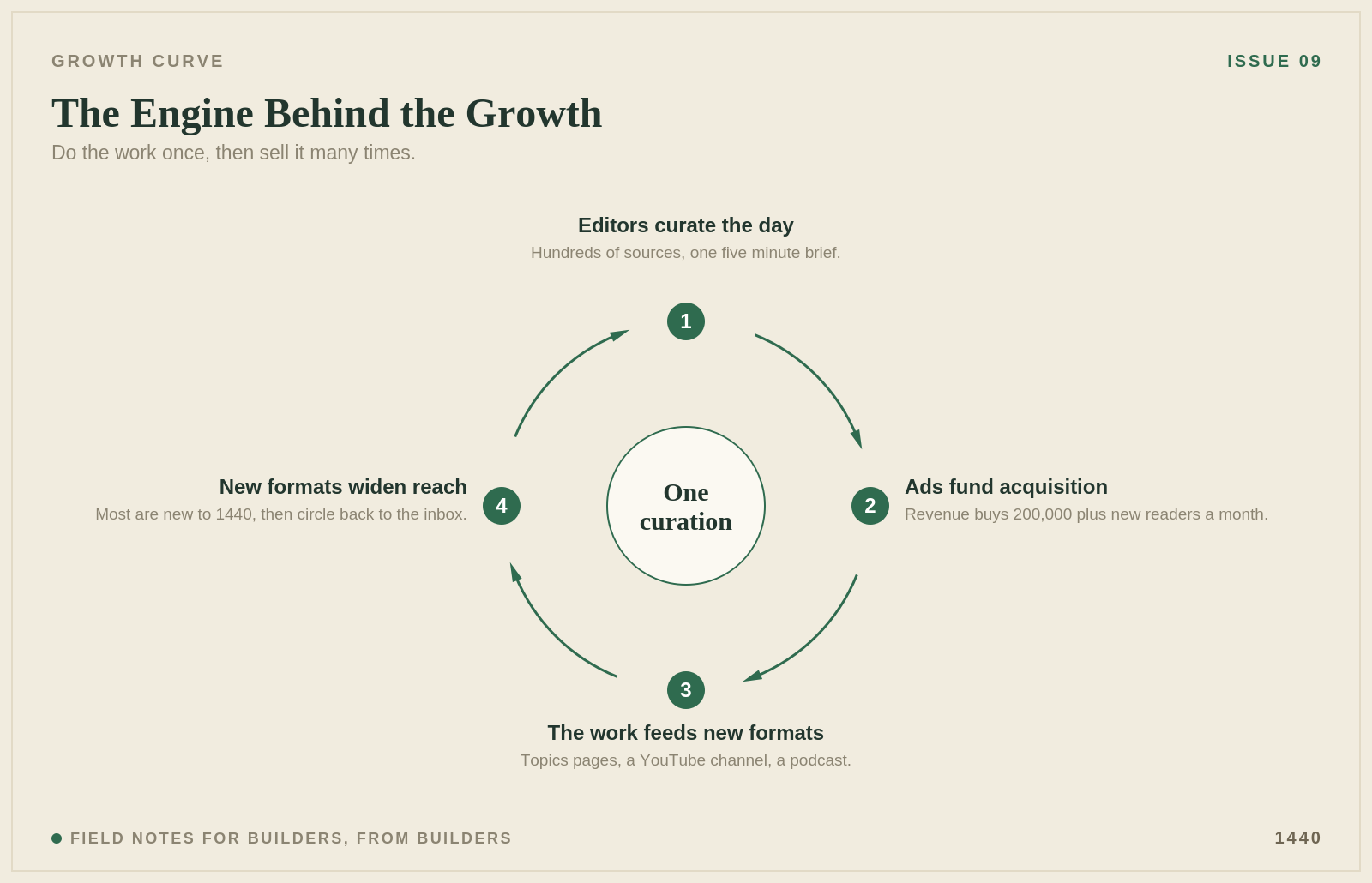
In October 2024, alongside passing four million subscribers, the company launched Topics, a web product of explainer pages built from the same research that feeds the newsletter. By mid-2026, it had grown to around 600 pages. Huelskamp has described the idea as what Reddit and Wikipedia would produce together if everything were curated by people and checked for accuracy. Topics deepen engagement among existing readers and enable 1440 to sell larger sponsorship packages. A YouTube channel that launched around 2025 has reached about 166,000 subscribers, and roughly 80% of its viewers are new to the brand. The podcast has passed 500,000 downloads. A further product, described internally as an Instagram for curious people, is planned. Each addition reaches readers through curation the team was already doing, so the marginal cost of each new format stays low.
Where 1440 Stands Now
The flagship Daily Digest is approaching five million free subscribers. In its final edition of 2024, the company said it had sent more than a billion emails, recorded more than 600 million opens, and grown to 4.1 million readers over the year. By mid-2026, the audience was near 4.6 million. The company remains in Chicago, is bootstrapped, and is owned mostly by its founders and employees. The brief still arrives every morning in the same restrained tone that defined it from the start, covering a little of everything while keeping overt opinion to a minimum. The plain style that most publishers treat as a weakness is the thing 1440 built its product around, and it broadened the audience enough to support a profitable business with one of the largest email lists in America.
-------
*** Every week, we pick apart how the world's best media brands got to where they are. This post is the long read. Growth Curve, our weekly newsletter, is the sharp version: same insight, shorter format, straight to your inbox. Subscribe free here. ***
-----------
Your newsletter won't build itself.


The 2000s Blog That Keeps Finding New Monetization Models
How Deadspin's Former Staff Built a Worker-Owned Media Company Without Outside Investors
Inside Puck’s Bet on Writer Ownership