How a Member-Owned Co-op Turned Its Catalog Into One of the Largest Outdoor Publishers in America

*** Every week, we pick apart how the world's best media brands got to where they are. This post is the long read. Growth Curve, our weekly newsletter, is the sharp version: same insight, shorter format, straight to your inbox. Subscribe free here. ***
------------
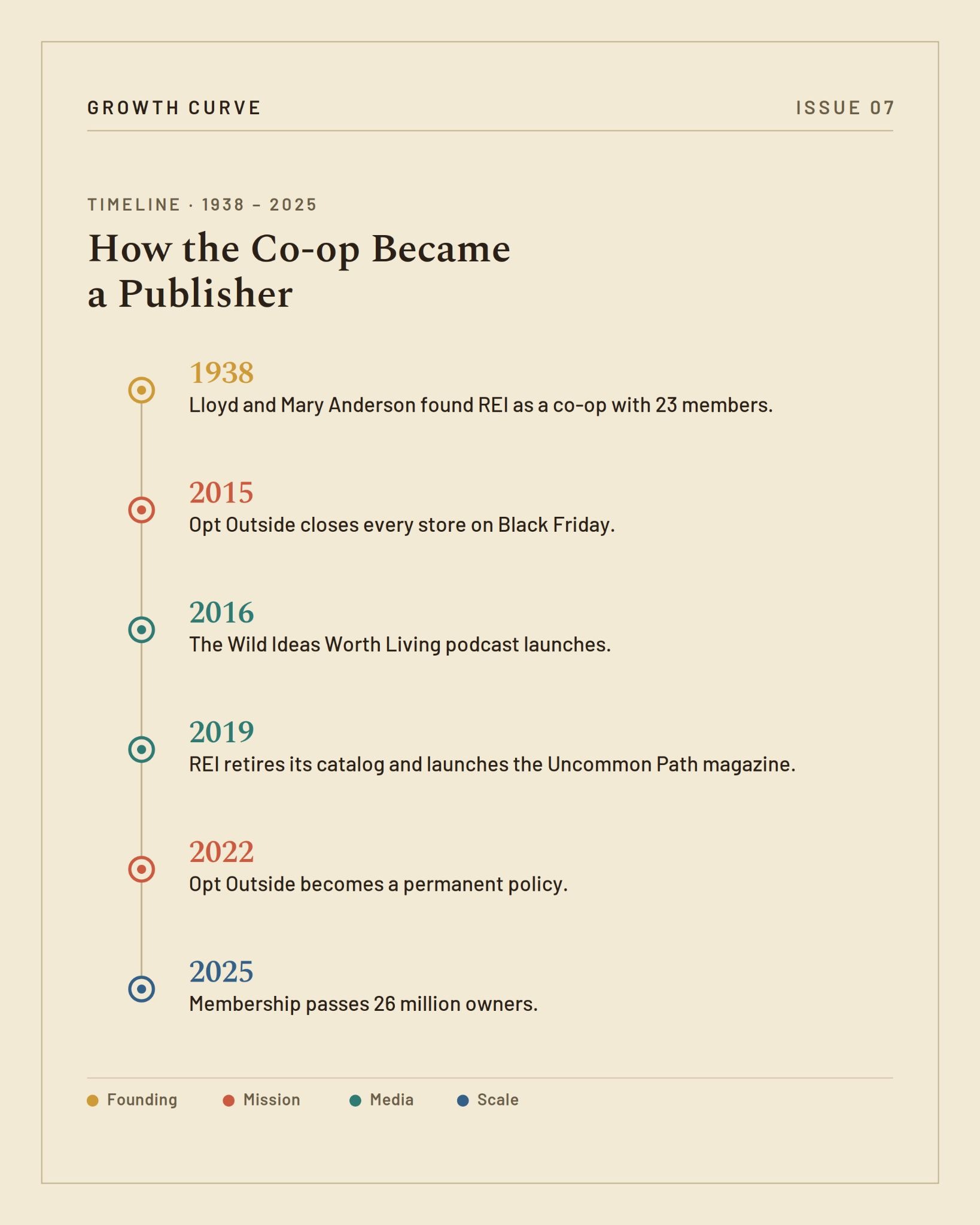
In the mid-1930s, a Seattle climber named Lloyd Anderson wanted a good ice axe. The ones sold locally cost around $20 and disappointed him. Using his German, he ordered one directly from Austria for about $3.5. His friends in The Mountaineers climbing club wanted the same deal. In 1938, Anderson and his wife Mary formalized the arrangement as a cooperative. Twenty-three climbers each paid $1 for a lifetime membership, and the Andersons held cards 1 and 2. By the end of that first year, the co-op had 82 members, $1,361 in sales, and a $212 surplus that the members split among themselves. That surplus was the first dividend. The dividend is the reason the company still works the way it does.
Recreational Equipment Inc. became the largest outdoor retailer in the United States. Along the way, it also became one of the largest outdoor publishers in the country, running a quarterly print magazine, an online journal, and a podcast that had been going for years. A retailer at that scale usually treats content as a line under the marketing budget. REI staffed an editorial team, funded reporting it did not control, and built properties that could hold a reader on their own.
Members Own the Company
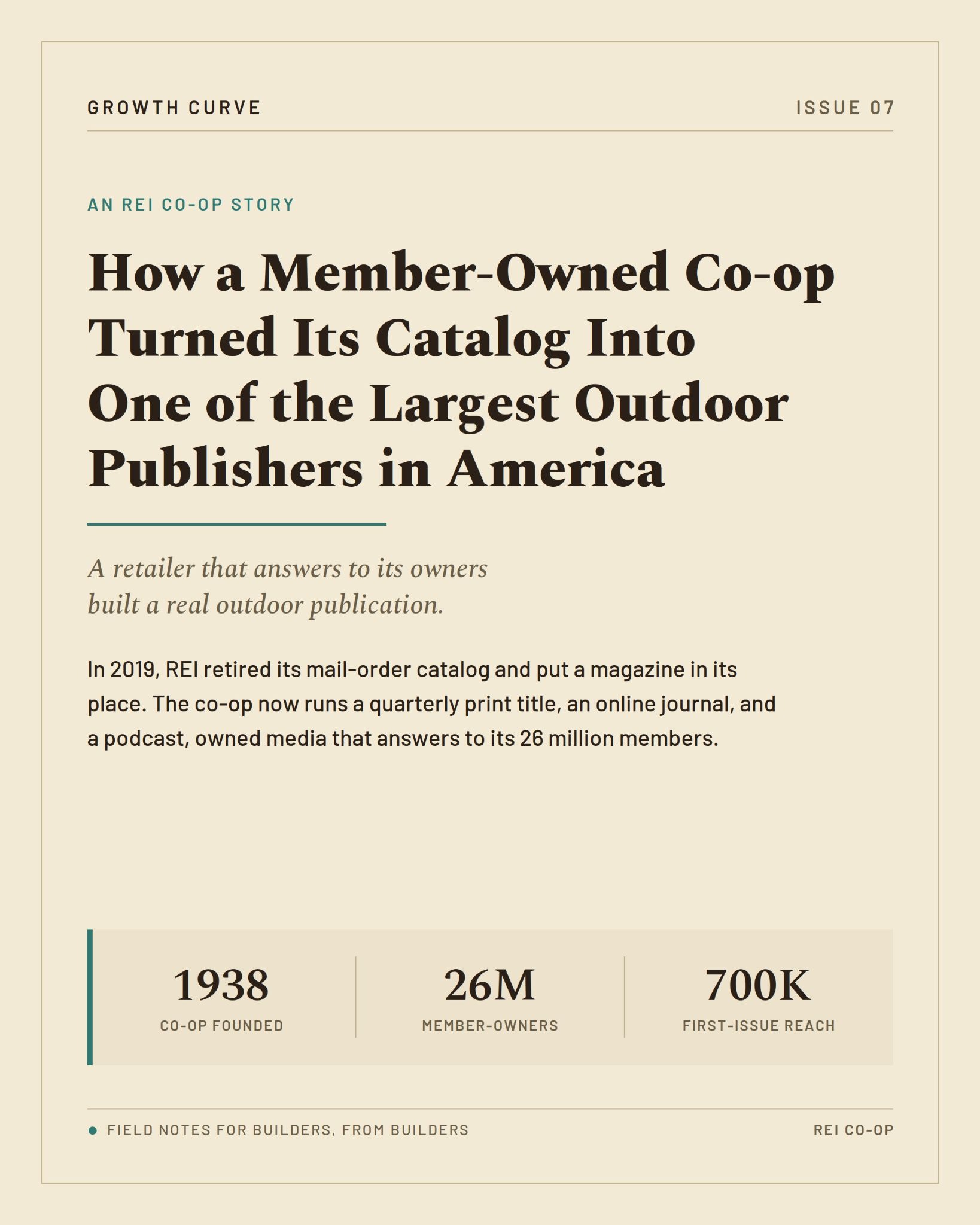
The co-op structure is plain and unusual. A one-time $30 fee makes someone a lifetime member. Members earn an annual Co-op Member Reward of roughly 10% on eligible purchases, vote in board elections, and share in the company's results. The co-op grew slowly for decades and then quickly. Jim Whittaker, the first American to reach the summit of Everest, became its president in 1971 and opened the first store outside Seattle in 1974. By 1983 it was the largest consumer cooperative in the country, with nearly 500,000 members and $85 million in sales. By the end of 2025, REI counted more than 26 million members, having added a million that year. In early 2026, its Member Month distributed around $200 million in member rewards. The company runs about 195 stores and employs roughly 14,000 people. The audience and the owners are the same group of people.
That arrangement removes a pressure that shapes most brand media. REI's content reaches an audience that already owns the company. The purpose of its publication was to deepen that relationship and serve the co-op's purpose of awakening a lifelong love of the outdoors.
It Retired the Catalog
For decades, REI mailed a full-price product catalog to members. In 2019, the co-op retired that catalog and replaced it with a magazine. Uncommon Path debuted that fall as an 84-page quarterly, announced at the Outdoor Retailer Summer Market in Denver. REI built it with an in-house team of seven editors and partnered with Hearst Magazines, whose branded content studio handled advertising relationships, copy editing, and layout. Hearst publishes more than 300 titles, from Cosmopolitan to Car and Driver, and lent the co-op its production muscle while REI kept the editorial direction. The first issue reached about 700,000 readers through newsstands, REI stores, and members' mailboxes. Outside magazine's print circulation at the time was roughly 675,000. When the magazine launched, REI's mailing list had already reached 17 million members. A retailer's first magazine reached the scale of an established outdoor title, carried there by an audience larger than that of most national publications.
The magazine runs adventure stories, profiles, gear writing, and reporting on issues facing the outdoors. The current issue is now available to members as a digital magazine through their REI accounts, with selected stories also available online.
The Journal Came First
The website predated the print edition. REI's editorial team has run the Co-op Journal, now published under the Uncommon Path banner, for years. It carries stories about people, places, and outdoor skills, along with a selection of features from each issue of the magazine. Its editors describe the goal as telling stories that make the outdoors feel welcoming to more people. The result is an owned channel that reads like a destination an enthusiast would visit.
A Decade of Episodes
The audio program is older than the magazine. Wild Ideas Worth Living began in 2016, is hosted by adventure journalist Shelby Stanger, and is fully supported by REI. By early 2026, the show had published more than 400 episodes and was still releasing one most weeks. Stanger interviews climbers, runners, authors, scientists, and entrepreneurs about the wild ideas they turned into reality. Guests have included Alex Honnold, Cheryl Strayed, Samin Nosrat, Scott Jurek, and Jimmy Chin. A single episode might feature an ultrarunner who logged more than a thousand straight days of running or a woman who rowed solo across the Atlantic. The show carries outside sponsors and has earned industry recognition as a branded podcast. The conversations sell nothing directly. They build the same thing the magazine builds, which is a reason to connect the co-op with a life spent outside.
It Closed the Stores to Make the Point
In 2015, REI did something a public retailer would struggle to defend to its shareholders. It closed all of its stores on Black Friday, one of the busiest selling days of the year, and paid its employees to spend the day outside instead. The campaign was called Opt Outside, and it ran as an open invitation for customers to do the same. Other brands followed the lead. REI made the closure permanent in 2022. The move was as much a media act as an operational one. The company spent its most valuable retail day on its calendar telling people to go outdoors.
It Funded Journalism It Did Not Control
The clearest sign of what REI's media optimized for arrived with the magazine. Alongside Uncommon Path, the co-op entered into a partnership with NewsMatch and committed $100,000 to 10 local nonprofit newsrooms covering environmental and outdoor issues. The launch cohort included InvestigateWest in Washington, Carolina Public Press in North Carolina, the Adirondack Explorer in New York, High Country News in Colorado, and Wisconsin Watch. A retailer paid for independent reporting it had no editorial control over. That is a strange line on a marketing budget and a sensible one for a member-owned co-op whose mission is the outdoors.
Where REI Stands Now
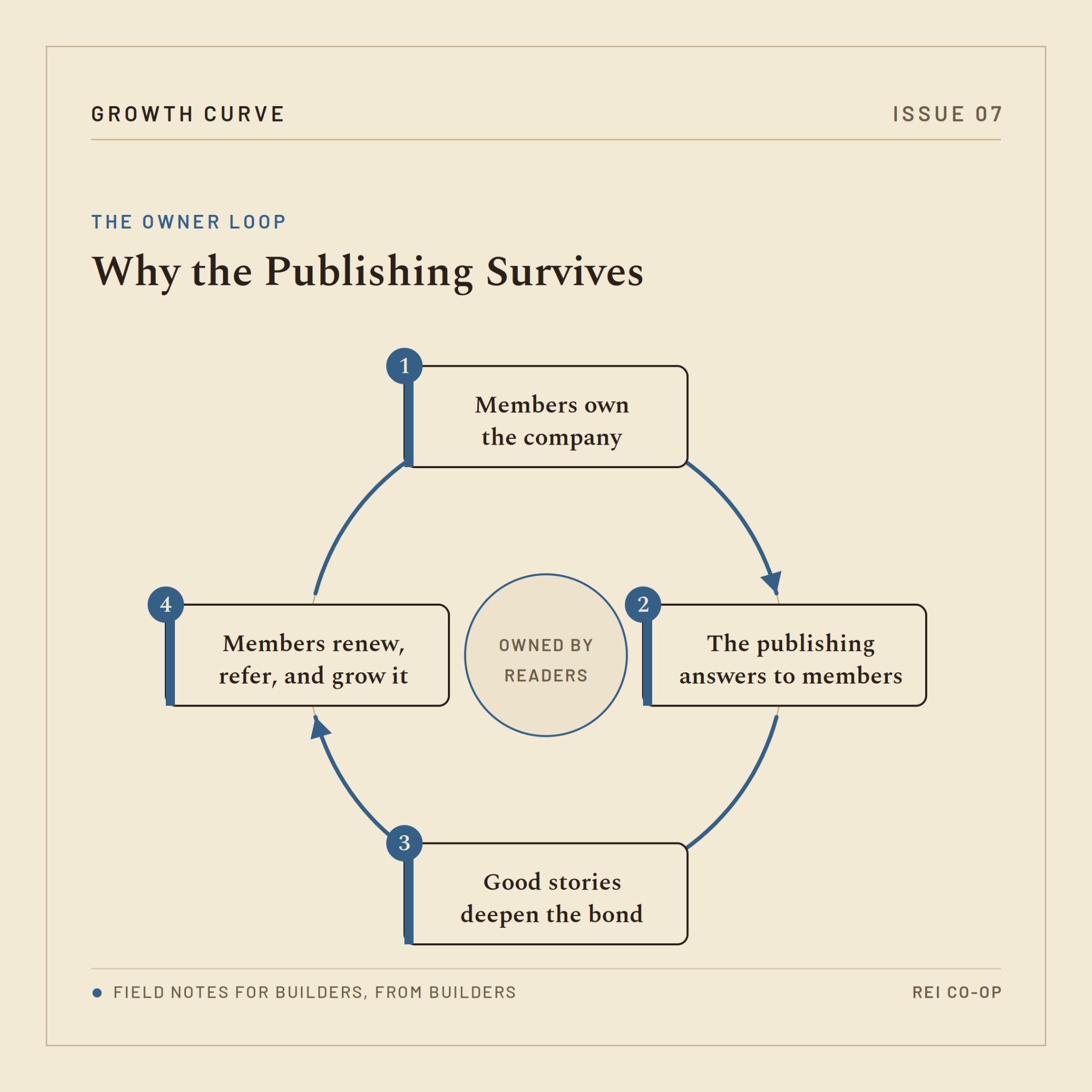
The pandemic-era boom in outdoor gear faded. Revenue fell 6.2% in 2024 to $3.53 billion, and the co-op posted a net loss of $156 million. It cut staff and shut down its decades-old Experiences division, which offered guided travel, tours, and classes. Eleven stores unionized, and in 2025 members voted down all three board nominees the co-op had put forward. A new chief executive, Mary Beth Laughton, introduced a three-year plan called Peak 28. In 2025, the co-op narrowed its loss to $54 million, with net sales of $3.54 billion, and closed the year with two profitable quarters.
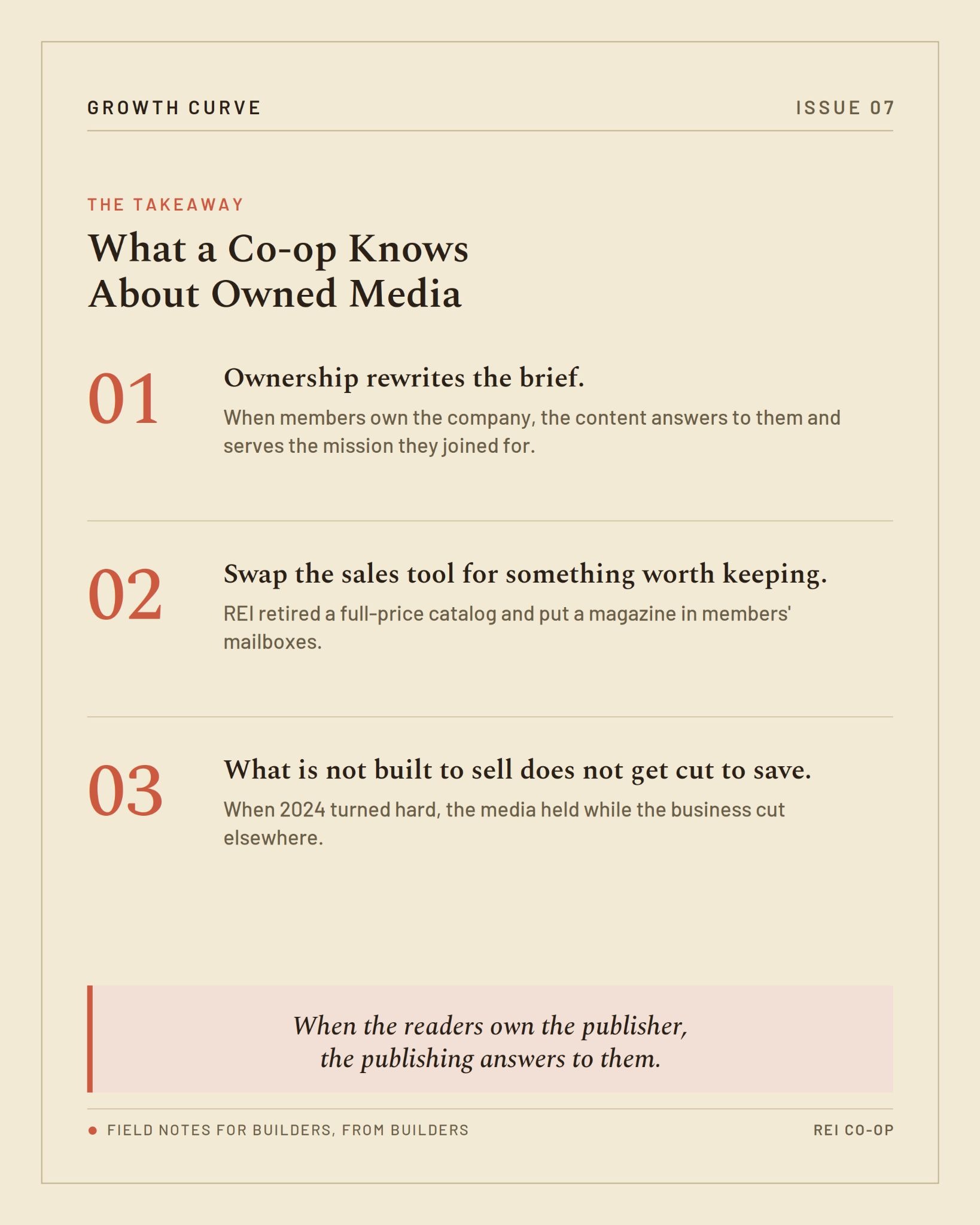
Through all of it, the publishing continued. Uncommon Path still ships to members. The Co-op Journal still posts. Wild Ideas Worth Living still releases a new episode most weeks. The media held its shape while the business cut elsewhere because it was built to serve the people who own the company and the mission they joined. When the readers own the publisher, the publishing answers to them.
Your newsletter won't build itself.


The 2000s Blog That Keeps Finding New Monetization Models
How Deadspin's Former Staff Built a Worker-Owned Media Company Without Outside Investors

Inside Puck’s Bet on Writer Ownership