How Deadspin's Former Staff Built a Worker-Owned Media Company Without Outside Investors

*** Every week, we pick apart how the world's best media brands got to where they are. This post is the long read. Growth Curve, our weekly newsletter, is the sharp version: same insight, shorter format, straight to your inbox. Subscribe free here. ***
In April 2019, the private equity firm Great Hill Partners bought Gizmodo Media Group and The Onion from Univision and combined them into a new company called G/O Media, led by former Forbes.com chief executive Jim Spanfeller. Deadspin, the sports site Will Leitch had founded in 2005, was part of the deal. That summer, Deadspin published a piece about its new owner. In October, editorial director Paul Maidment sent a memo instructing the staff to keep every story connected to sports. Editor Barry Petchesky refused and was fired. Within days, the entire writing and editing staff resigned.
Over the following months, the group ran a pop-up site called Unnamed Temporary Sports Blog around Super Bowl weekend and again in April 2020. On July 28, 2020, The New York Times reported that 18 of the roughly 20 Deadspin staffers who had resigned were starting a subscription media company with Jasper Wang, a former Bain consultant and longtime Deadspin reader. The company had no outside investors, and each founder held a stake of roughly 5%. Defector launched in September 2020.
In its November 2025 annual report, Defector said it had grown to 27 employees while retaining all 19 original co-founders. Across its first five reported years, the company recorded a small operating surplus each year, showing that a worker-owned newsroom can pay its staff, keep its core team together, and sustain the business without outside capital.
The Ownership Structure
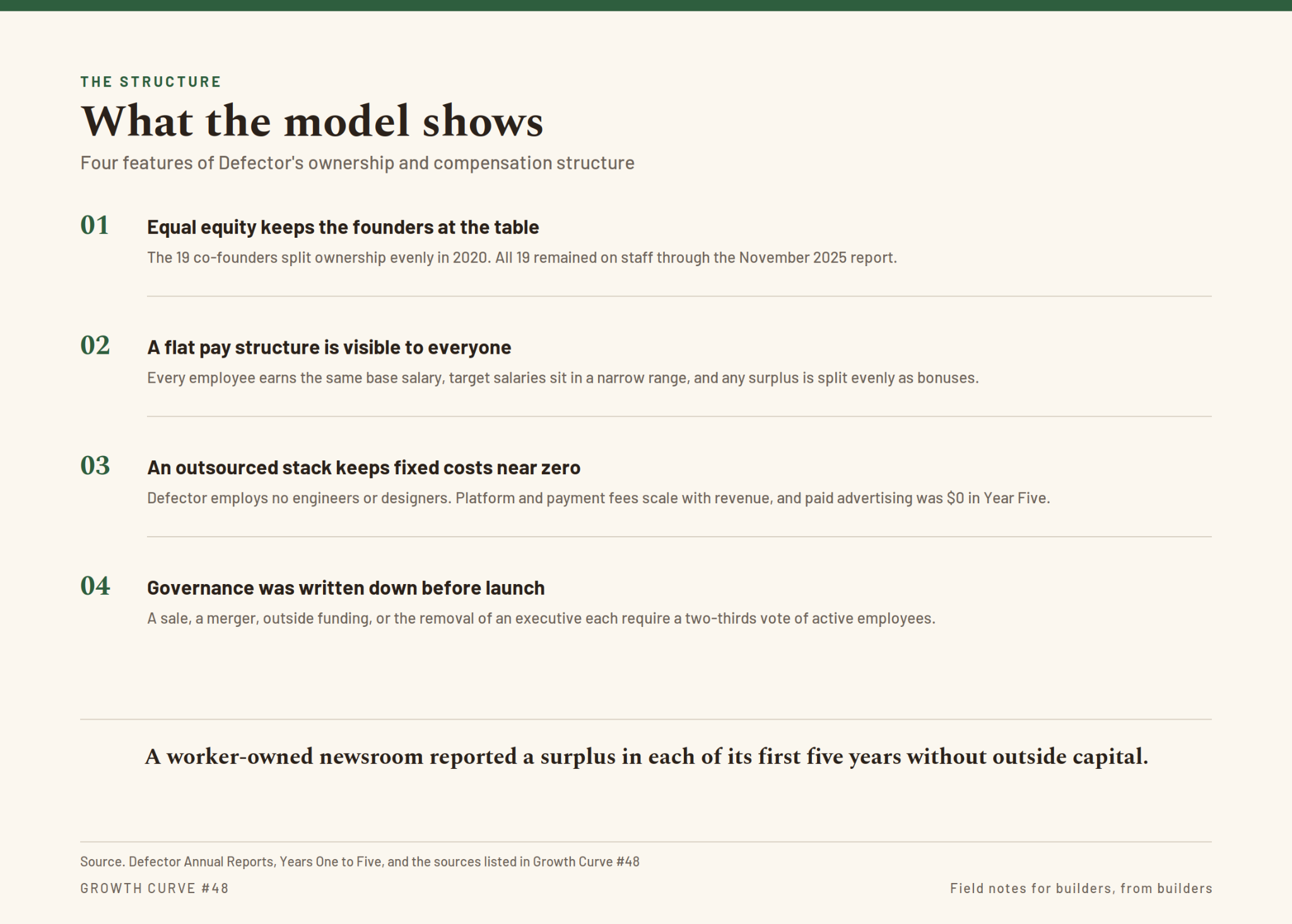
Defector's founders split the initial equity equally, and every later hire has received an economic interest through a company distribution plan. Defector Media is a member of the U.S. Federation of Worker Cooperatives. The founding documents require a two-thirds vote of the company to sell or merge the business, raise equity or take on meaningful debt, hire or fire executives, or change the board. Ley and Wang can both be removed by that vote.
Voting rights belong only to active employees. The company created two classes of shares to separate a financial stake from a governance stake. When an employee leaves, their shares convert one-for-one into a non-employee class with no voting or dividend rights.
The Compensation Structure
Cash compensation at Defector has three layers. Every employee receives the same base salary. Each position carries a target salary above the base within a narrow range, paid out quarterly based on the previous quarter's actual financial results. Once all targets are paid and the business has set aside what it needs to reinvest, any remaining funds are distributed evenly as bonuses. Every employee knows every other employee's target salary and what they have received each quarter.
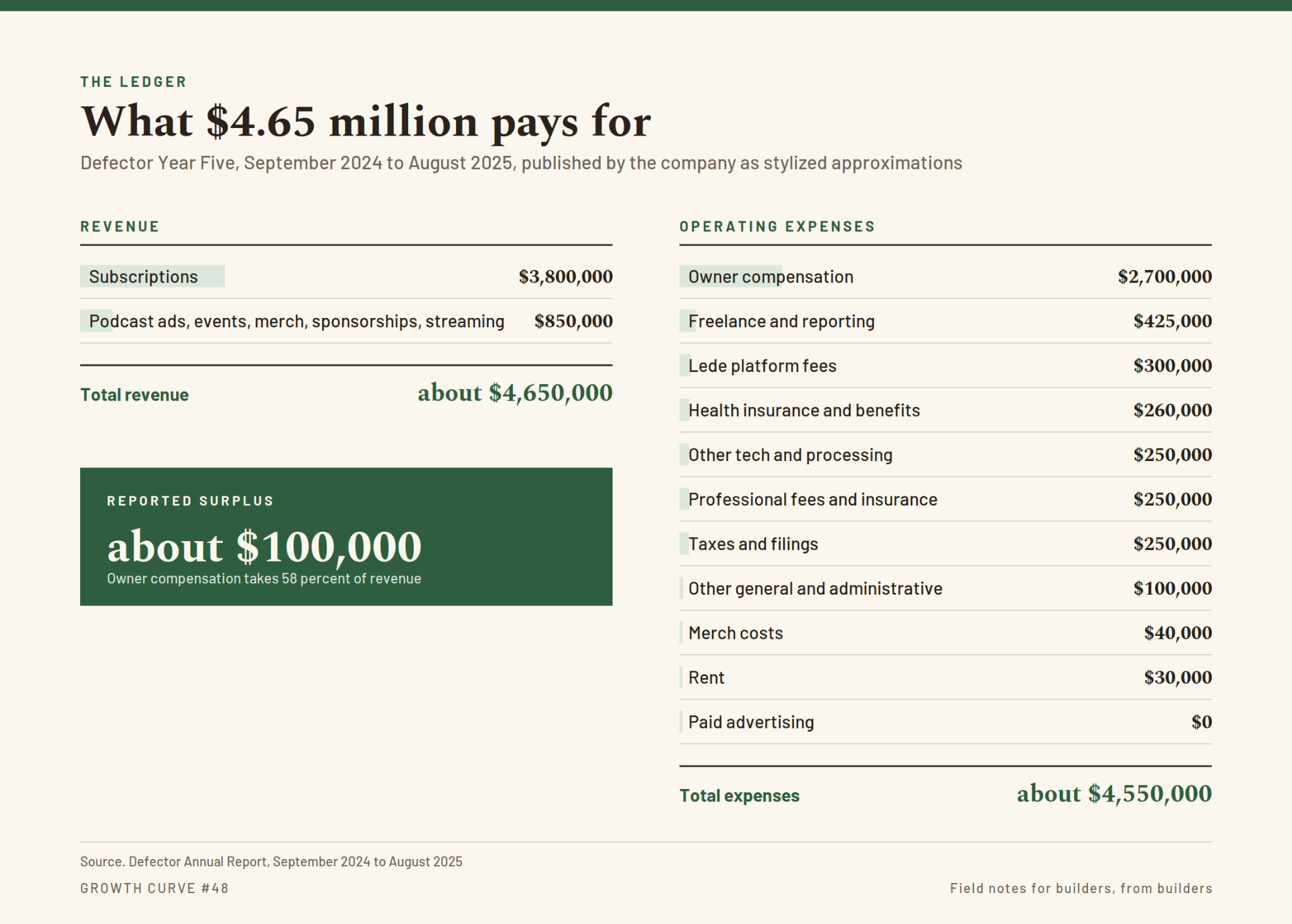
Owner compensation was the largest expense from the start, at $1.7 million in year one with 23 employees. By Year five it had reached $2.7 million, with a further $260,000 for health insurance and benefits, against reported revenue of about $4.65 million.
The structure works because its best-known writers keep their work inside Defector. Each owner is expected to devote at least 75% of their professional effort to the company. In early 2020, Drew Magary and David Roth were offered a sizable deal to start a podcast for Stitcher, but they waited until Defector launched before signing the contract with the company. Later that year, Kelsey McKinney tweeted an idea for a gossip podcast and was contacted by a major talent agency within 24 hours. She chose to develop the show through Defector instead.
The Numbers
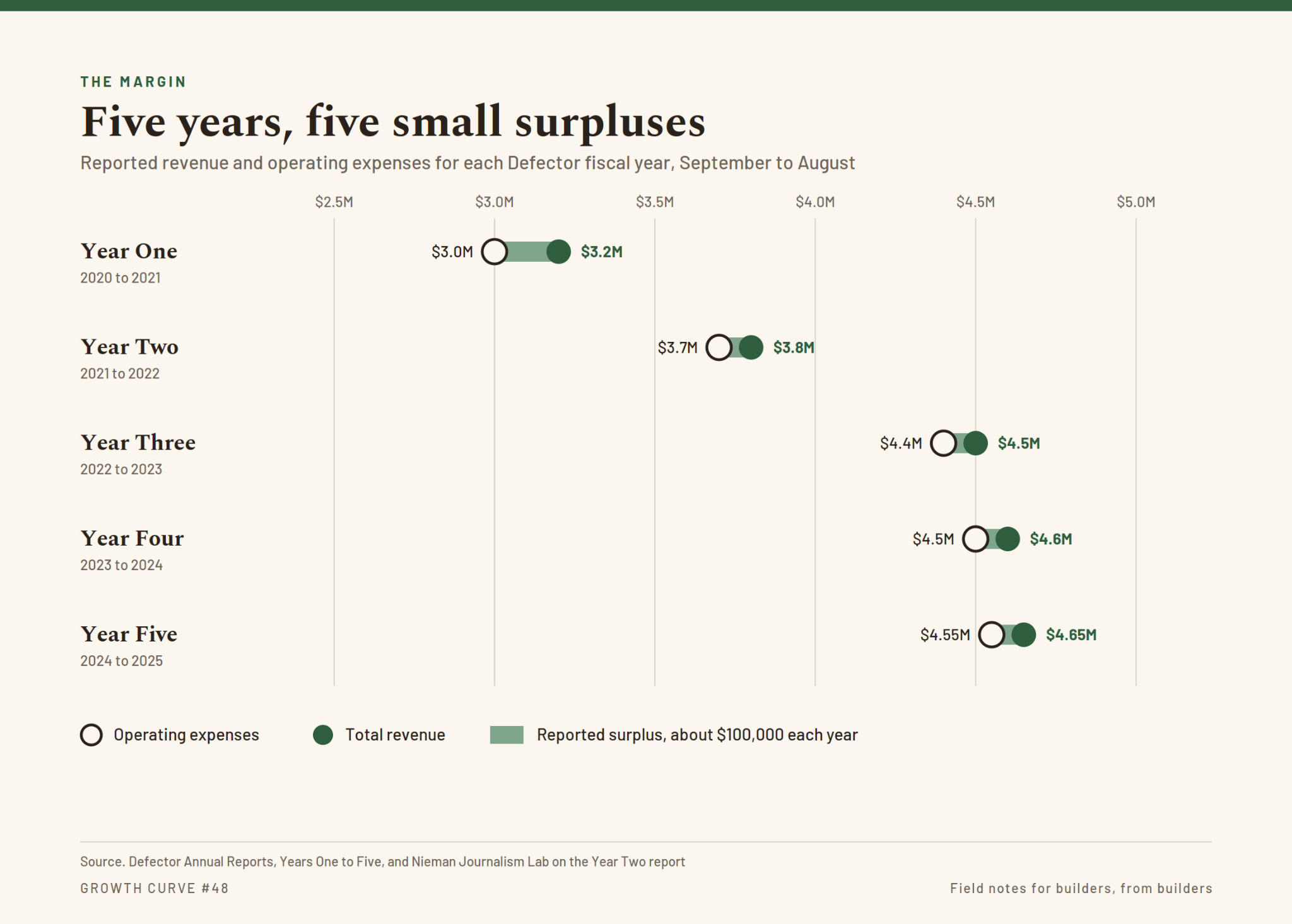
Before publishing a single post, Defector had more than $1 million in prepaid subscriptions, according to the year four report. On September 30, 2021, the company had 36,000 active subscribers, 95% of its $3.2 million in first-year revenue came from subscriptions, and more than 80% of subscribers were on annual plans. Renewal among annual subscribers was about 86%.
Revenue reached about $3.8 million in year two with 38,000 active subscribers, $4.5 million in year three with 42,100 subscribers, and $4.6 million in year four with 42,500 subscribers. In Year five, subscription revenue held flat at $3.8 million, other revenue grew to $850,000, total revenue came to roughly $4.65 million, and operating expenses came to roughly $4.55 million.
Prices have not changed since launch. A base Reader subscription costs $8 per month or $79 per year, Pal tier costs $119 per year, and the Accomplice tier costs $1,000 per year. The company modeled a price increase in 2022, concluded it would increase total subscription revenue, and ultimately declined to implement it.
Running Lean
Defector has never employed a product manager, engineer, or designer. The site runs on Lede by Alley, with Pico for subscriptions and Stripe for payments, and most of those fees are calculated as a percentage of revenue. Lede fees were $300,000 in year five. Rent was $30,000. Paid advertising was $0, down from $30,000 in year one, after the company judged its Twitter ad returns insufficient and said it did not expect to ever buy Facebook ads.
The savings went into editorial. Freelance and reporting spend rose from $100,000 in year one to $425,000 in year five, and the company worked with about 150 outside writers, editors, illustrators, producers, and crossword designers that year. For site sponsorships, advertisers paid Defector a small fixed fee upfront and an additional amount for every new subscriber the campaign generated. The company refused advertising from sports-betting companies. Display ads for non-subscribers arrived only in late 2024, brokered by BuySellAds, after Wang wrote that subscription revenue growing in the low single digits could not fund the additional workforce they needed.
The Podcast
Normal Gossip launched on January 5, 2022, created by McKinney and Alex Sujong Laughlin, with McKinney as host and Laughlin as producer. In February 2023, the show joined PRX’s Radiotopia network, which handled distribution, advertising sales, and marketing, while McKinney and Laughlin kept ownership of the show and control over its creative direction. By December 2024, Vulture reported that the show had generated around 45 million downloads across roughly 70 episodes. That month, McKinney and Laughlin stepped away from the show, with Rachelle Hampton taking over as host and Se'era Spragley Ricks as producer. McKinney and Laughlin remained on Defector's staff. Live tours in 2023, 2024, and 2025 added ticket revenue.
Podcast advertising helped push non-subscription revenue from $200,000 in year one to $850,000 in year five. A biweekly Normal Gossip newsletter, launched in April 2024, reached more than 10,000 readers.
Where Defector Stands Now
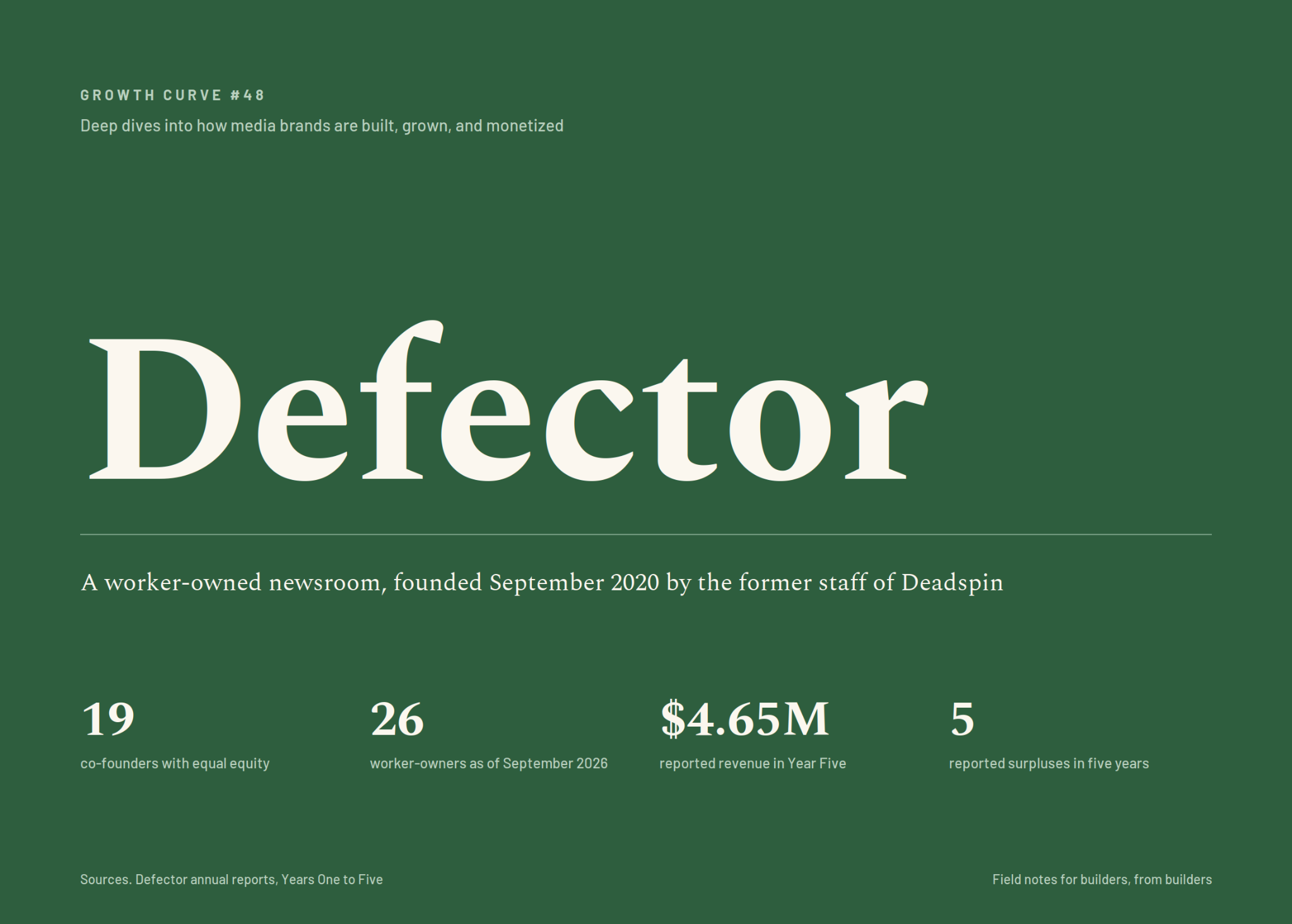
Defector enters its seventh year on September 10 with 26 worker-owners and about 40,000 subscribers. The product has continued to expand. In July 2025, Defector announced two new podcasts and the acquisition of the basketball show Nothing But Respect. The Span, its first dedicated culture newsletter, launched in March 2026.
In the year five report, Wang wrote that staff stability lowers recruiting and onboarding costs and builds the trust needed for difficult conversations. It also constrains the company. Because Defector has never taken outside capital, it can reshape its staff only through incremental hiring and only when revenue can support the additional cost. In July 2025, Press Forward awarded $1.5 million to Start.coop, with Defector as a co-applicant, to build shared back-office services for worker-owned newsrooms.
Defector’s lesson is not that every newsroom should become worker-owned. It is that durable media businesses are built when the people creating the audience, the product, and the revenue all have incentives to stay. The result is a business that has grown slowly, but with far less pressure to chase traffic, inflate headcount, or compromise the product to satisfy investors. For an industry that has spent two decades optimizing for scale, Defector is a reminder that a smaller, tightly aligned media company can still be a very good business.
*** Every week, we pick apart how the world's best media brands got to where they are. This post is the long read. Growth Curve, our weekly newsletter, is the sharp version: same insight, shorter format, straight to your inbox. Subscribe free here. ***
Your newsletter won't build itself.


The 2000s Blog That Keeps Finding New Monetization Models
How Deadspin's Former Staff Built a Worker-Owned Media Company Without Outside Investors
Inside Puck’s Bet on Writer Ownership