How Casey Newton Tested Whether a Subscription Business Could Survive Leaving Its Distribution Platform


*** Every week, we pick apart how the world's best media brands got to where they are. This post is the long read. Growth Curve, our weekly newsletter, is the sharp version: same insight, shorter format, straight to your inbox. Subscribe free here. ***
------------
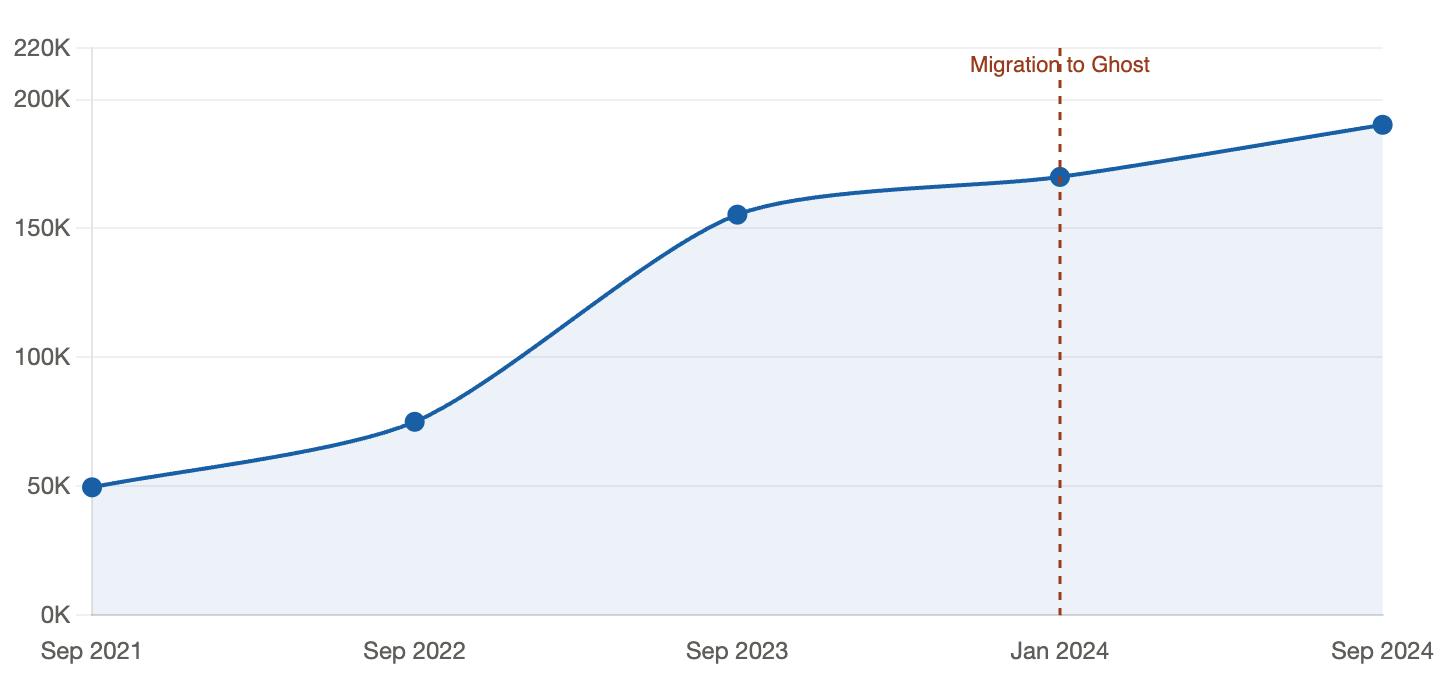
In January, 2024, Casey Newton announced that Platformer, the tech newsletter he had built on Substack since October 2020, would migrate to Ghost, a nonprofit open-source publishing platform. The publication had grown from the roughly 24,000 free subscribers Newton brought with him when he left The Verge to more than 170,000 at the point of migration. It was one of the most-read independent tech newsletters in the United States, and Substack, which took 10% of its subscription revenue, considered it one of the platform's flagship publications.
Newton was leaving because of moderation. In November 2023, Jonathan M. Katz reported in The Atlantic that Substack hosted scores of white-supremacist and explicitly Nazi newsletters, including at least sixteen using overt Nazi symbols in their logos. On December 21, co-founder Hamish McKenzie responded that Substack would not remove or demonetize them. Newton and managing editor Zoë Schiffer identified seven publications that they considered to express explicit support for 1930s Nazis and threats of violence against Jews, sent six to Substack as a test of the company's stated rules, and watched Substack remove five of them. The company declined to commit to a forward-looking policy and, in Newton's account, leaked the scope of Platformer's findings to a friendlier publication on the platform to minimize the story.
The core question of the migration was: If one leaves the platform that has been responsible for a meaningful share of your distribution, does the business survive? Two years later, the answer is on the record.
The Founding Setup
Platformer was not a typical Substack publication. Newton had been the Silicon Valley editor at The Verge for seven years and had previously built a newsletter, The Interface, at Vox Media. When he left in October 2020, he migrated approximately 24,000 subscribers from that prior list into Platformer. He did not arrive on Substack as an unknown writer building an audience from scratch. He arrived as an established beat reporter, porting an existing readership into a new business structure that let him keep most of the revenue.
The deal he signed with Substack reflected that. Substack paid to design Platformer's logo, covered a year's worth of healthcare stipends, offered legal support, and connected Newton with advisors. Newton declined the writer's advance that Substack was offering to some new arrivals. He kept 90% of subscription revenue and, under Substack's standard terms, retained full ownership of his subscriber list. That subscriber list was a real asset. It was Newton's, not Substack's.
Through 2021 and 2022, the publication did what subscription newsletters are supposed to do. Newton was joined by Zoë Schiffer, formerly of The Verge, as managing editor. By September 2023, on the third anniversary, Platformer had about 155,000 free subscribers, of whom roughly 5% were paying around $10 a month or $100 a year. That implied annual gross subscription revenue was close to $775,000 before Substack's 10% cut and Stripe's processing fees. The growth in 2023 was rapid and unusual. Newton later attributed much of it to a stream of news scoops and to Substack's recommendation and Notes features, which pushed Platformer to readers of other publications. By the time of the migration in January 2024, the free subscriber base had grown to more than 170,000.
Why Newton Thought the Business Would Survive
Newton was explicit in his exit post and in the months that followed about what made the migration possible. Platformer owns its email list. Substack's portability terms meant that subscriber names, email addresses, and payment information could be exported and resumed on Ghost without asking readers to re-subscribe or re-enter card details. Stripe, which processed payments on Substack, continued processing them on Ghost. From the reader's perspective, the next Tuesday edition arrived as usual, with the only visible change being the URL.
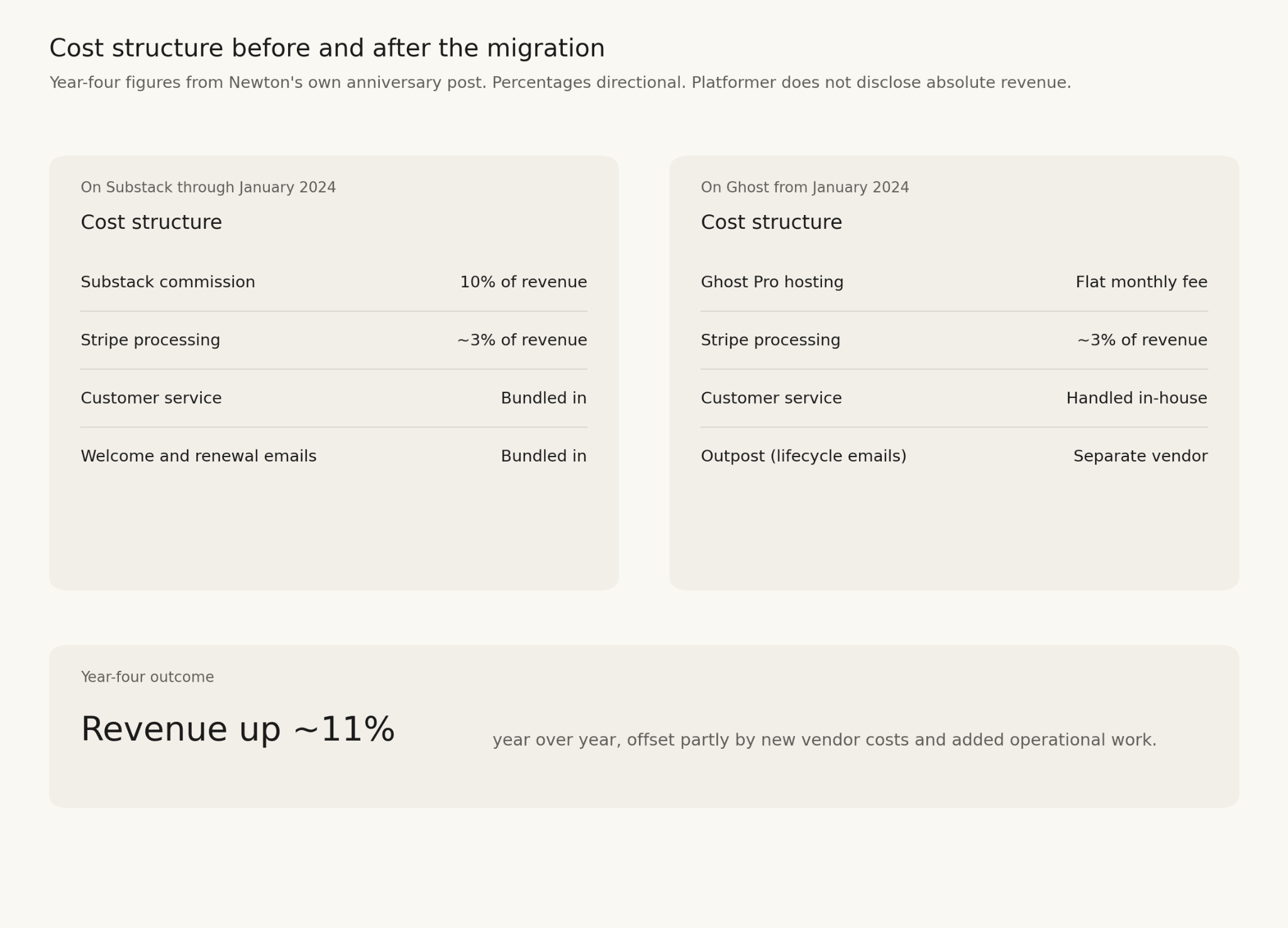
The business case for the move was straightforward. Substack's 10% commission on a publication earning close to a million dollars in subscription revenue was a six-figure annual line item. Ghost Pro, the managed hosting service run by the nonprofit Ghost Foundation, charged a substantially smaller flat fee. Newton's calculation was that even after paying Ghost Pro, contracting a third-party service called Outpost for welcome and renewal emails that Substack had handled in-house, building a redesigned site, and taking customer service in-house across the three-person team, the publication would still pay less than it had been paying Substack.
The risk case was that Substack's recommendation network and Notes feature had become a meaningful subscriber acquisition channel by late 2023, and that Platformer would lose that channel entirely on Ghost. Newton acknowledged this directly. Substack had been generating a non-trivial share of his free signups, particularly through cross-recommendations from other tech-adjacent publications. The expectation was that the migration would slow new subscriber acquisition and reduce conversion rates from free to paid, because new readers on Ghost would have to manually enter their credit card details rather than upgrade with one click from the cards Substack already had on file.
What Actually Happened
In September 2024, eight months after the migration, Newton wrote the fourth-anniversary post. Platformer had 190,196 subscribers, up about 35,000 from the year before. The growth rate had slowed compared to 2023, which Newton attributed to both the absence of Substack's discovery tools and to 2023 being an unusually news-heavy year that inflated the prior baseline. He described the new growth as slower but more durable than what Substack's recommendation flywheel had been producing.
Revenue was up roughly 11% year over year. Part of that reflected keeping the 10% that Substack had previously taken. Part of it was offset by new expenses, including Ghost Pro fees, Outpost services, the redesign, and customer service work. The publication also launched a single paid advertisement slot in its free weekly newsletter and brought in close to six figures in first-year ad revenue under Schiffer's management. By the fifth-anniversary post in September 2025, Newton described Platformer as a stable, mature business supporting thousands of paid subscribers and a small newsroom of three people. He was also honest about the costs. Growth had slowed further. The combined loss of Substack's network and the deteriorating utility of Twitter for promotion had cost Platformer a distribution channel it had not fully replaced.
Why It Survived
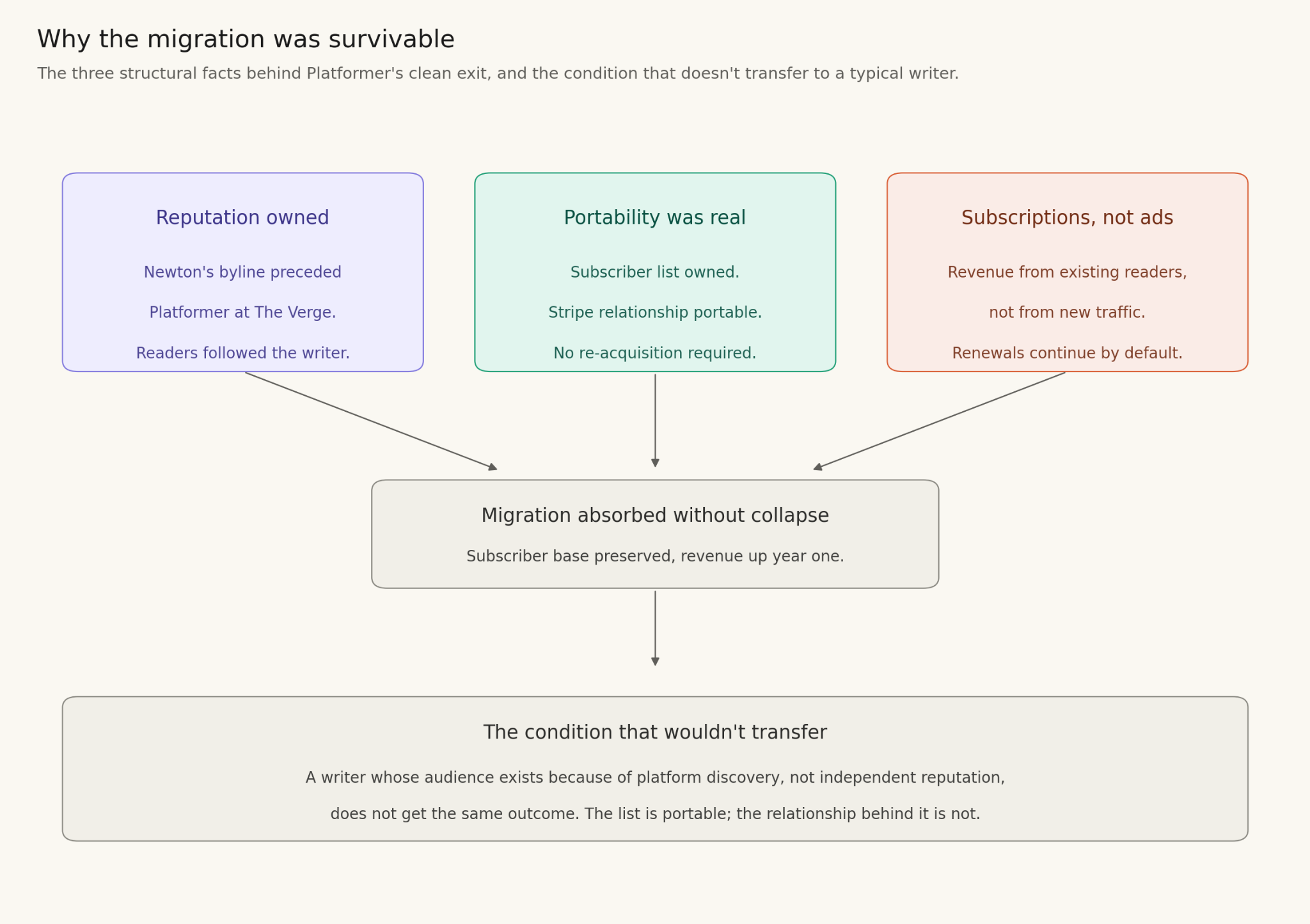
Three structural facts explain why a publication can leave a network with that much distribution leverage and still grow.
The first is that Platformer's authority was not borrowed. Newton had spent seven years at The Verge before launching Platformer and was already a known beat reporter on tech platforms and democracy. When he moved, the readers followed. The publication's reputation was the asset, and that asset was portable in a way that subscriber lists alone are not. A writer whose audience exists because of platform-driven discovery rather than independent reputation would not have been able to make the same move at the same survival rate.
The second is that Substack's terms allowed the move. The 10% commission and the portability of subscriber lists were deliberate design choices made in 2017 by founders who believed that letting writers leave was the only way to convince them to stay. That guarantee was expensive for Substack when high-profile writers exercised it, but it was the same guarantee that had attracted those writers in the first place. Platformer's exit is, in this sense, evidence that the founding promise was real.
The third is that the subscription economics of a serious independent publication are more resilient to a distribution shock than those of an equivalent ad-supported publication. Platformer's revenue does not depend on traffic. It depends on a few thousand readers continuing to pay roughly $10 a month for work they trust. Those readers do not need to be re-acquired every month from a recommendation feed. Once converted, they renew unless something specific causes them to cancel. Losing Substack's discovery surface meant slower acquisition of new paid subscribers. It did not mean losing the existing ones.
It would be tempting to read Platformer's survival as evidence that any subscription publication can leave its platform without consequence. The case does not support that.
Newton migrated with an established byline, a paid subscriber base in the thousands, a co-editor with operational skill, and three years of editorial momentum behind him. He had a specific moral reason to leave that resonated with a meaningful share of his readers, several of whom upgraded to paid subscriptions in the days after the move to support the decision. He moved to a nonprofit platform whose own incentives aligned with his, and whose founder publicly committed to removing pro-Nazi content. None of those conditions is guaranteed for a typical writer considering the same move.
What the case does establish is that a subscription business whose value to its readers derives from the writer rather than from the platform can absorb the loss of a distribution channel, even a significant one, without collapsing. Substack provided real value to Platformer, both through network effects and through payment and product infrastructure. But it did not provide what readers were actually paying for: Newton and Schiffer's reporting. When the platform's policies became incompatible with the publication's editorial position, the publication could bear the costs of slower growth, greater operational complexity, and lost discovery without losing the underlying business.
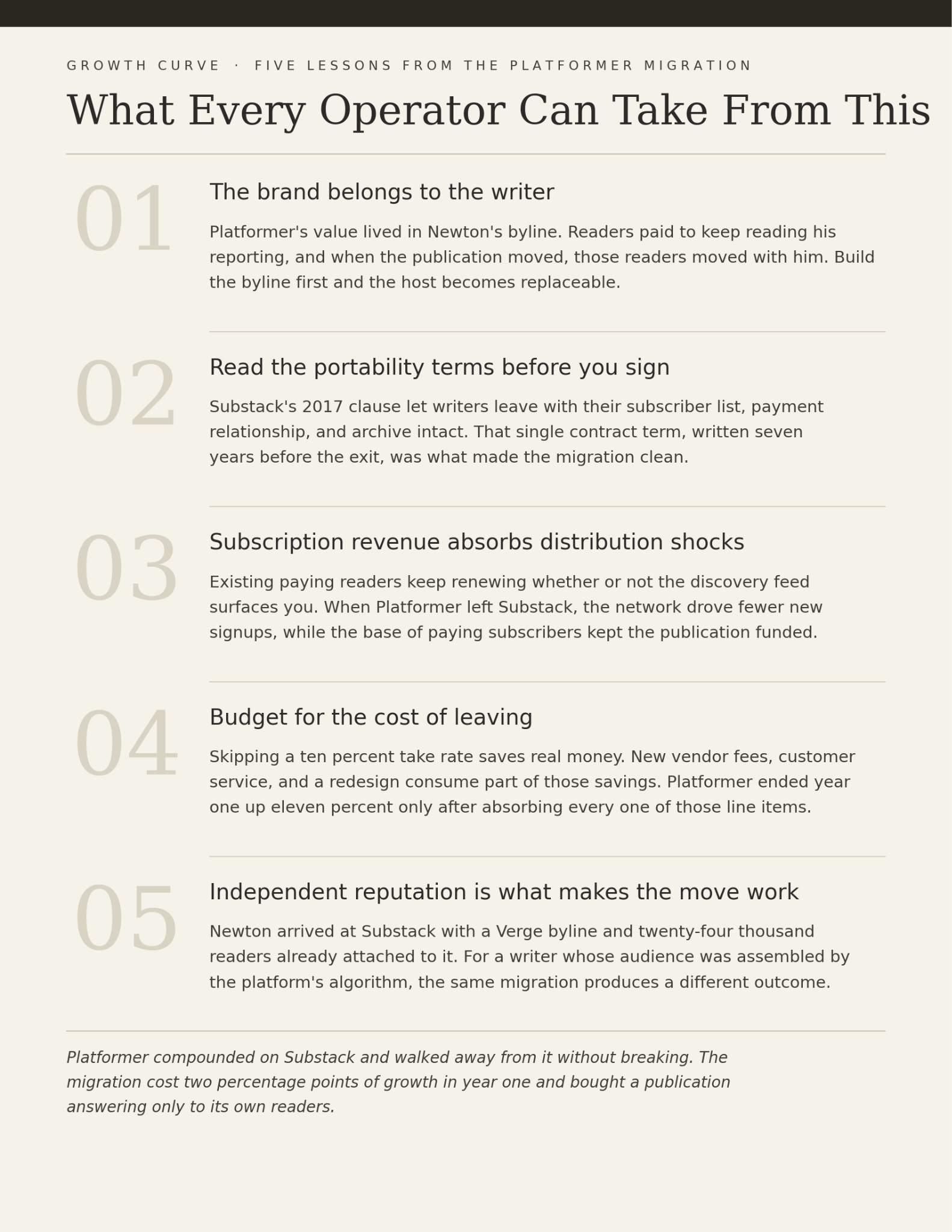
That is a useful test result for any operator running a subscription business on someone else's infrastructure. Platform migrations are not easy and costless. If the value you're subscribing to is genuinely your own work rather than the platform's distribution, the math of leaving is survivable. The corollary is also worth taking seriously. A writer whose audience exists because the platform's algorithm chose to show their work would not have the same outcome, because what is portable in that case is the email address, not the relationship behind it.
Your newsletter won't build itself.


The 2000s Blog That Keeps Finding New Monetization Models
How Deadspin's Former Staff Built a Worker-Owned Media Company Without Outside Investors
Inside Puck’s Bet on Writer Ownership