How an Irish Brewery Built the Authority on Human Achievement


*** Every week, we pick apart how the world's best media brands got to where they are. This post is the long read. Growth Curve, our weekly newsletter, is the sharp version: same insight, shorter format, straight to your inbox. Subscribe free here. ***
------------
On a November day in 1951, Sir Hugh Beaver, the managing director of the Guinness Brewery, was at a shooting party in County Wexford. He missed a shot at a golden plover and got into an argument over whether the plover or the red grouse was the fastest game bird in Europe. That evening, he tried to settle the question and found that no reference book in the house could answer it.
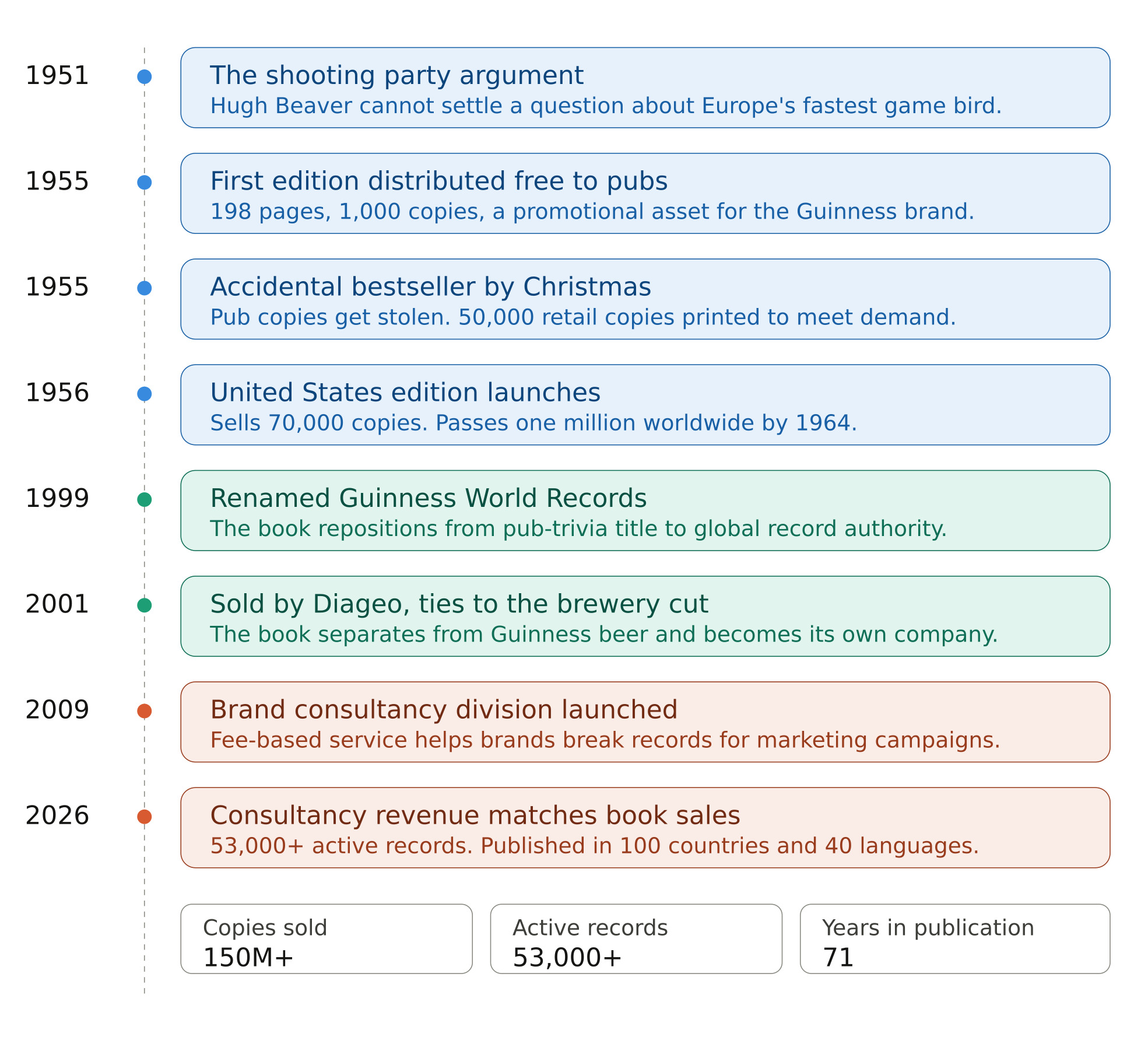
He concluded that millions of similar arguments were unfolding every night across the roughly 81,000 pubs of Britain and Ireland, and that there was no book anywhere designed to end them. Three years later, Guinness commissioned twin brothers Norris and Ross McWhirter to compile one. The first edition was bound on 27 August 1955, and a thousand copies were distributed free to pubs as a promotional asset for the Guinness brand.
Seventy years later, that promotional asset is the authority on what counts as a world record. It decides whether a feat is real, sells around 3.5 million books a year, and runs a consultancy that the top brands in the world pay to be associated with. The Guinness Book of Records is a near-exact parallel to the Michelin Guide. A drinks company built a publication to sell its product, and the publication outgrew the product so completely that it eventually separated from it entirely.
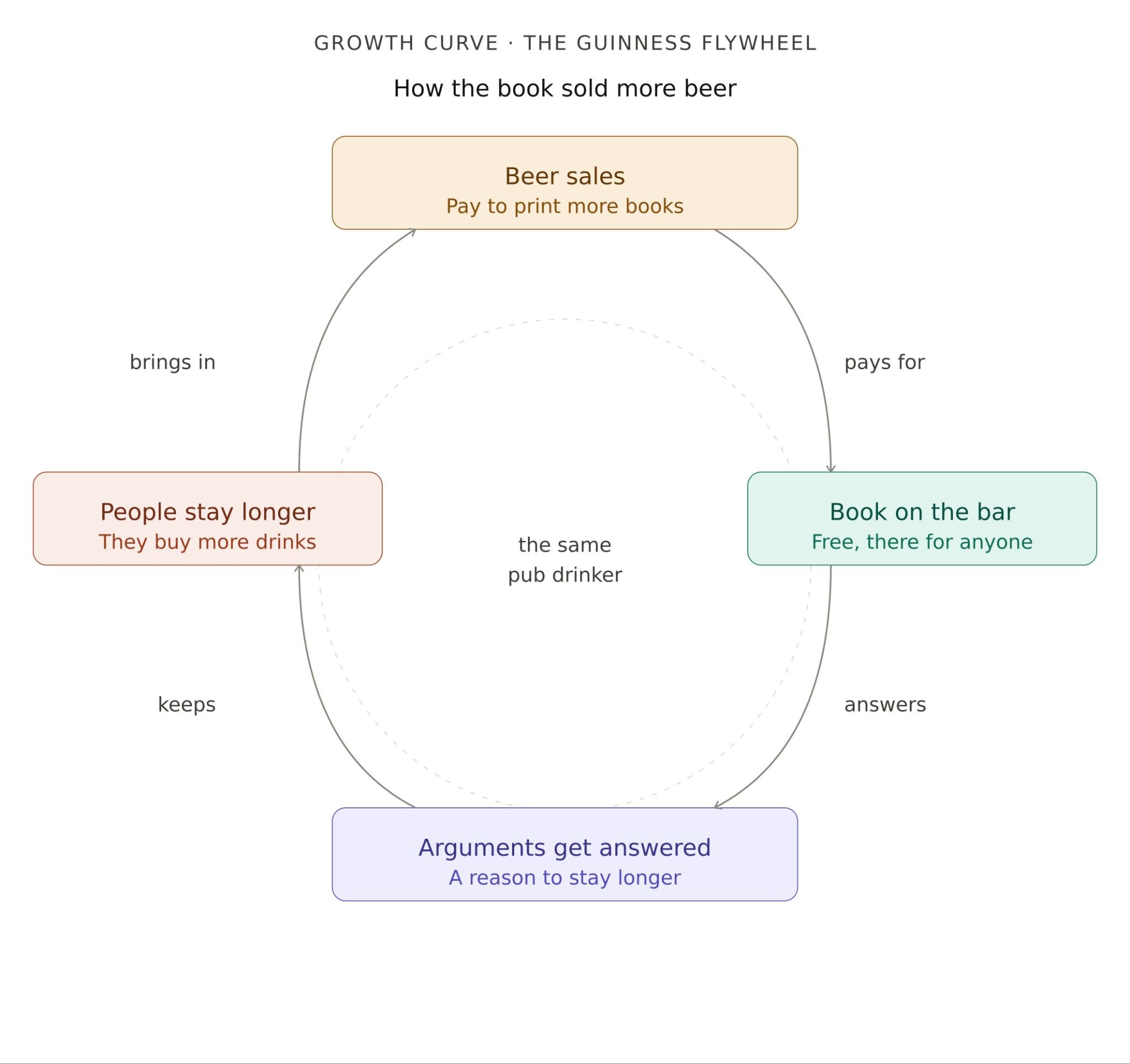
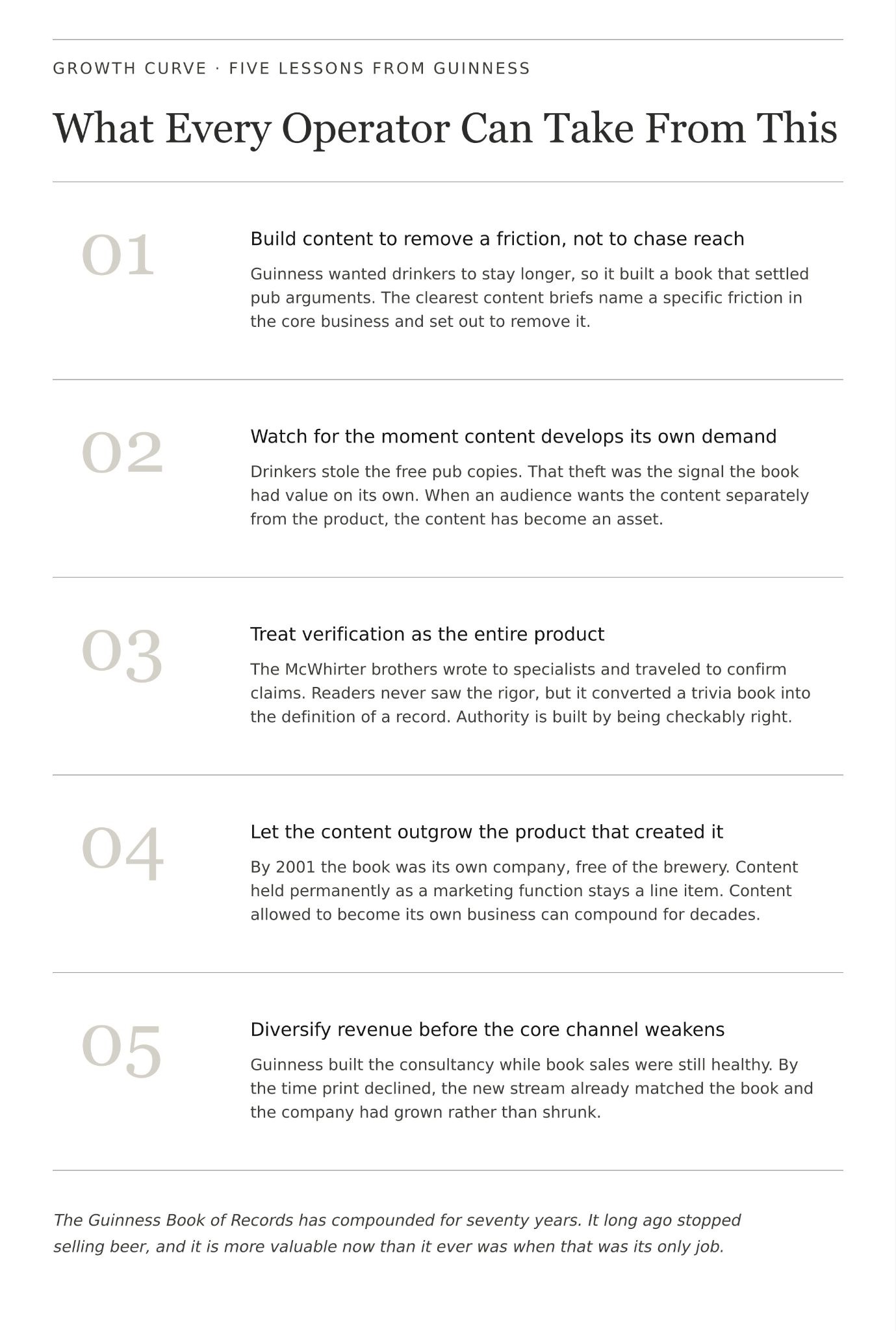
The original idea was narrow and commercial. Guinness wanted pub-goers to spend more time and more money in pubs, and a pub that could settle an argument was a pub people stayed in. A reference book chained to the bar was a reason to order another pint while someone looked something up. The book did not need to make money. It needed to make the pub stickier, and the cost of printing a thousand copies was trivial against the volume of stout that a stickier pub would move.
The publication existed to increase the value of an evening already being spent in a Guinness pub, not to convert readers into customers. Beaver was not building a media product. He was removing a minor source of friction that kept customers from staying longer.
The Accidental Bestseller
The book behaved in a way Beaver had not planned for. The free pub copies were so popular that customers stole them. Guinness realized it had created demand for the book itself, separate from the demand for beer, and printed 50,000 more copies for retail sale. By Christmas 1955, the Guinness Book of Records was the top-selling book in Britain. By 1964, it had passed a million copies worldwide.
A book that millions of people buy and trust becomes a credentialing body because being listed in it is now worth something in its own right. Guinness had set out to make pubs stickier and had accidentally built the global registry of human achievement.
What turned the book from a popular curiosity into an institution was the McWhirter brothers' fact-checking. The twins ran a Fleet Street fact-finding agency before Guinness hired them, and they treated the book as a research project rather than a marketing one. They wrote to astrophysicists, zoologists, and gerontologists. They traveled personally to verify claims. The first 198-page edition took 13.5 90-hour weeks to assemble.
Once Guinness World Records said a record was the record, the claim was settled because the alternative was to argue with the only organization that systematically verified records. The McWhirters' diligence is what allows a brewery's giveaway to serve as the body that adjudicates truth in this category.
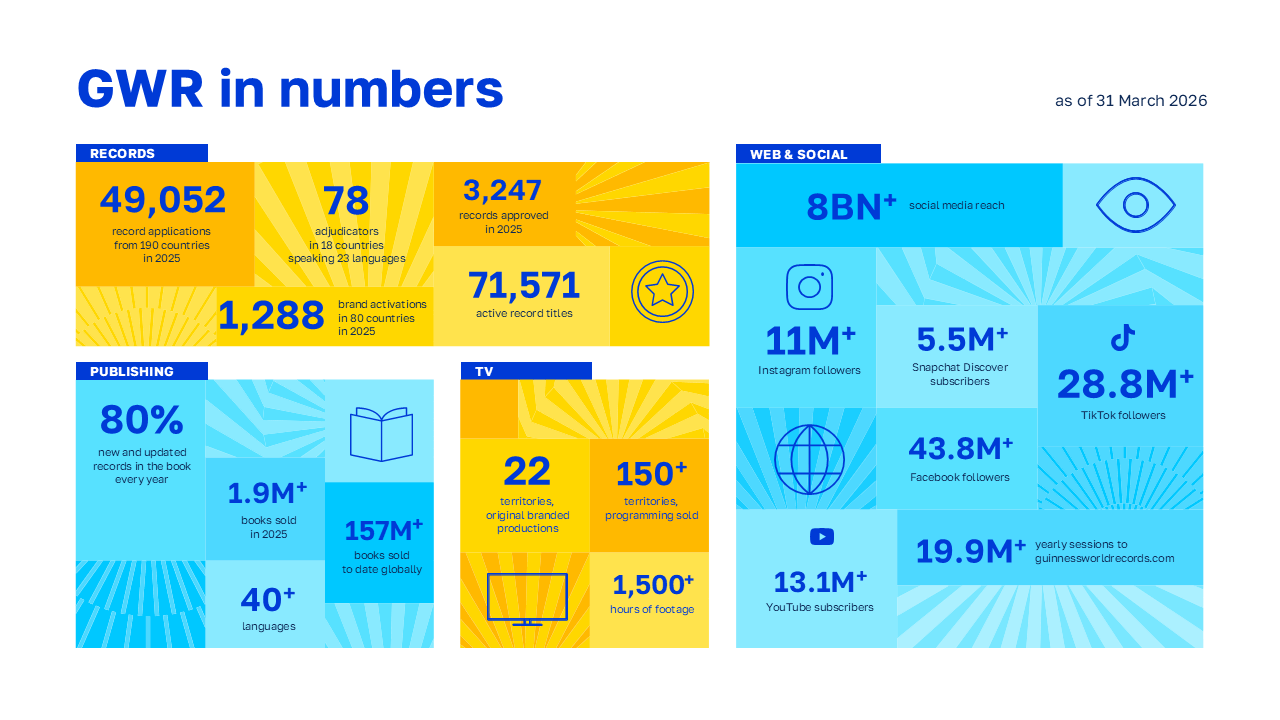
That adjudication is now formalized. Guinness World Records maintains a database of more than 53,000 active records and receives thousands of applications a month. It writes the guidelines, supplies the evidence requirements, and decides what does and does not qualify. No competitor has ever displaced it.
The Separation From Beer
The Michelin Guide is still owned by the tire company. Guinness World Records is not. The book passed from Diageo, the drinks group that owns Guinness, to Gullane Entertainment in 2001, severing its ties to the brewery. The publication had become valuable enough to stand on its own, and a beverage conglomerate had no particular reason to run a reference-book-and-media business.
This is the part of the story most relevant to operators. A piece of content created to serve a core product can, if it compounds far enough, become an asset worth more as an independent entity than as a marketing line. Guinness the beer and Guinness World Records now share only a name and an origin story. The publication retained the brand equity, McWhiter rigor, and authority. The brewery kept the beer. Both were better off, which is the best possible evidence that the book had outgrown its original purpose.
The Modern Revenue Model
For most of its life, the book was the business. That changed in the late 2000s, when physical publishing weakened and Guinness World Records built a second revenue stream that now matches the book in size. The consultancy.
The consultancy sells brands the right to break a record on purpose. Any individual can attempt a record for free, but a company attempting one for promotional reasons is routed into a fee-based, account-managed division. Guinness World Records helps the brand find a recordable feat, adjudicates the attempt, and licenses the use of its logos in the resulting campaign. Consultations start at around £11,000 and can run much higher for complex mass-participation records.
A brand can stage a spectacle on its own, but it cannot certify the spectacle as a world record. Only Guinness World Records can do that, and the certification is what makes the campaign newsworthy. LG used a record to demonstrate a washing machine's reduced vibration. Volvo Trucks used one to make a product film people actually watched. Of the top 100 brands in the world, more than half have held a Guinness World Records title. The consultancy is, in effect, the company renting out the credibility its own book spent decades accumulating.
To an individual, a Guinness World Records title sells recognition. To a brand, a record is a story that the press will cover, and audiences will share because the format carries built-in legitimacy. That is the asset Guinness World Records monetizes.
Why It Compounded
Three decisions explain why a brewery giveaway became a standalone institution.
The first was hiring verifiers rather than marketers. The McWhirter brothers treated accuracy as the entire job. That rigor was expensive and mostly invisible to readers, but it is what converted a trivia book into the definition of a record. Authority is the moat, and authority is built only by being consistently right.
The second was letting the book separate from the beer. Guinness did not force the publication to remain a marketing instrument once it had outgrown that role. By 2001, the book was its own company, free to build a consultancy, television series, and museums without reference to whether any of it sold stout. Content that is allowed to become its own business can compound indefinitely.
The third was diversifying before the core product began to decline. Guinness World Records built the consultancy in the late 2000s, while book sales were still healthy, but not after they collapsed. By the time physical publishing genuinely weakened, the consultancy already matched the book, and the company had grown rather than shrunk.
-------
*** Every week, we pick apart how the world's best media brands got to where they are. This post is the long read. Growth Curve, our weekly newsletter, is the sharp version: same insight, shorter format, straight to your inbox. Subscribe free here. ***
Your newsletter won't build itself.


The 2000s Blog That Keeps Finding New Monetization Models
How Deadspin's Former Staff Built a Worker-Owned Media Company Without Outside Investors
Inside Puck’s Bet on Writer Ownership