How to Build a B2B Newsletter Strategy From Scratch in 2026


Most B2B newsletters fail for the same reason.
Not because the writing is bad. Not because the topic is wrong.
They fail because the person who started them never defined what success looked like. So when month three arrives and growth looks flat, there’s no reason to keep going.
This guide is a practical framework for building a B2B newsletter strategy before you write a single word. Work through the seven steps below and you’ll have:
- A clear goal
- A defined audience
- A format that fits your resources
- A growth plan
- A way to measure whether any of it is working
Skip them and you’ll have a newsletter that runs out of momentum by spring.
Before You Start: One Mindset Shift
A blog is a document. A newsletter is a relationship.
That distinction changes more than you’d expect.
It means your newsletter shouldn’t sound like a blog post reformatted for email. It means you’re not publishing content — you’re showing up consistently for a specific group of people who asked to hear from you.
The standard for “good enough” isn’t “accurate and professional.” It’s: Would a smart colleague forward this to someone?
Keep that image in mind as you build your strategy. Every decision gets easier when you’re asking:
Would a person send this? Rather than: Does this represent the brand?
Step 1: Define What Success Looks Like
Do not start a newsletter without answering this question:
What do you want this newsletter to do for your business?
There are three legitimate primary goals for a B2B newsletter. They’re not mutually exclusive, but one must come first.
1. Lead Generation
The newsletter exists to bring qualified prospects into your pipeline.
Success looks like:
- Subscribers converting into sales conversations
- Measurable contribution to pipeline
If this is your primary goal:
- Every issue should include a clear, relevant CTA
- Subscriber acquisition should target your ICP specifically
2. Brand Authority
The newsletter exists to position your company as the most credible voice in your space.
Success looks like:
- Being cited, forwarded, and referenced
- Industry recognition
If this is your goal:
- Original insight matters more than frequent CTAs
- Depth beats volume
3. Customer Retention
The newsletter exists to keep existing customers engaged and reduce churn.
Success looks like:
- Product adoption rates
- Renewals
- Expansion revenue
If this is your goal:
- Your subscriber list is essentially your customer base
- Content helps customers get more value from what they already bought
Before moving to Step 2, write your goal in one sentence. For example:
“Our newsletter generates qualified sales conversations from B2B operations leaders at companies with 50–500 employees.”
Vague goals produce vague newsletters.
Step 2: Know Exactly Who You’re Writing For
Most B2B guides get this wrong:
Your newsletter subscriber is not the same as your ICP.
Your ICP defines the type of company you’re targeting.
Your newsletter subscriber is a specific person inside that company — someone more willing than their peers to invest in their own development, more open to new ideas, and more likely to become an internal champion.
Write for that person.
A weak subscriber definition:
“Marketing leaders at B2B companies.”
A strong one:
“Heads of marketing at B2B SaaS companies with 25–150 employees who are trying to build a content engine without a full team.”
To get that level of specificity, answer three questions:
- What is their job?
Not just their title. What are they responsible for? What does their week look like? What stands between them and hitting their goals? - What do they want to learn?
Not what you want to teach. What are they actively searching for? Asking about in Slack groups? Paying to attend conferences to understand? - What does a useful Tuesday morning in their inbox look like?
If they read your newsletter at 8am and describe it over coffee, what do they say?
Build your strategy around those answers — not around what’s convenient for you to write.
Step 3: Choose Your Format
There are three core newsletter formats. Each comes with trade-offs.
1. Curated
You collect the best content in your space and send it with brief commentary.
Pros:
- Easier to produce
- Lower barrier to consistency
Cons:
- Builds trust in your taste, not your expertise
- Rarely converts subscribers into buyers on its own
2. Original
Every issue contains ideas, analysis, or insights created by you.
Pros:
- Builds authority
- Positions you as the source
Cons:
- Higher effort
- Harder to sustain without a content engine
When someone acts on something you wrote, they associate the result with you — not with an article you linked to.
3. Hybrid (Recommended for Most B2B Companies)
One original section plus two or three curated links.
This format balances effort with authority-building.
- The original section is why people subscribe.
- The curated links are why they stay.
A simple structure:
- 200–400 words of original insight
- 2–3 curated links
- One-sentence annotation explaining why each link matters
Once you build rhythm, this is a high-value issue you can produce in under an hour.
Step 4: Set Your Cadence — and Protect It
Consistency is the most underrated factor in newsletter success.
A weekly newsletter that ships on time for a year will outperform a better newsletter that ships “whenever we can.” Every time.
Why?
Subscribers form habits. If your newsletter arrives every Tuesday at 8am, readers begin looking for it. It becomes part of their week.
Break the pattern and you lose the habit.
Choose a cadence you can sustain during your lowest-bandwidth week of the year — not your best week.
If you can’t reliably send weekly, send every two weeks.
Fortnightly and reliable beats weekly and erratic.
One practical rule:
Never miss twice in a row.
One missed issue is forgettable. Two signals the newsletter is dying.
Step 5: Build a Content Engine
By week six, most newsletter writers ask:
Where do the ideas come from?
The answer isn’t a content calendar. It’s a content engine.
A calendar tells you when to publish.
An engine tells you where the raw material comes from.
Three reliable B2B sources:
1. Customer Conversations
- Sales calls
- Client meetings
- Support tickets
When a client asks a question you hadn’t thought to answer — that’s an issue.
When you hear the same objection for the third time — that’s an issue.
2. Your Own Observations
- What surprised you this week?
- What’s changing in your space?
- What are you seeing that contradicts common advice?
Original observation is your competitive advantage.
3. Industry Signal + Your Take
- Product launches
- Regulatory changes
- New studies
Your job isn’t to report the news.
It’s to explain what it means for your reader and what they should do next.
The 30-Minute Writing Workflow
- Write the idea in one sentence.
- Write three reasons it’s true — or three ways to act on it.
- Write the opener last (1–3 sentences that make them need the rest).
- Add curated links with one-sentence annotations.
- Write one clear CTA.
That’s the issue.
Don’t make it longer than it needs to be.
Step 6: Grow Your Subscriber List Intentionally
A newsletter does not grow by itself.
Publishing great content is a retention strategy.
Growth requires acquisition.
First 100 Subscribers: Your Network
Email people you already know. Tell them what you’re building and who it’s for.
Yes, it feels uncomfortable.
Do it anyway.
Your first 100 subscribers form the foundation everything compounds on.
From 100 to 1,000: B2B Growth Tactics
1. Your Email Signature
Add a one-line description and subscribe link.
Every outbound email becomes a passive impression.
2. LinkedIn (Used Correctly)
Don’t post “Check out my newsletter.”
Share the core insight as a standalone post.
Mention that subscribers receive insights like this weekly.
Let the content sell.
3. Cross-Promotions
Partner with complementary newsletters that reach the same audience.
If you serve HR leaders, partner with a newsletter covering employment law or compensation benchmarks.
4. Content Upgrades
Offer a template, checklist, or resource inside a relevant blog post in exchange for subscription.
These subscribers are already engaged — high quality from day one.
Step 7: Measure What Actually Matters
Open rate is a hygiene metric — not a strategy metric.
Track these instead:
Reply Rate
The percentage of subscribers who reply.
This is the strongest signal of genuine engagement.
In B2B, replies often turn into warm leads.
Click-to-Open Rate
Of those who opened, how many clicked?
High opens + low clicks = strong subject line, weak content.
Subscriber Quality
Does your list match your ICP?
500 right-fit subscribers > 2,000 general readers.
If your list drifts off-target, adjust acquisition.
Pipeline Influence
Tag newsletter subscribers in your CRM from day one.
Track:
- Opportunity overlap
- Closed deals
Ten minutes of setup now gives you attribution data six months from now.
Growth vs. Churn
If growth is flat → acquisition problem.
If churn is high → content relevance problem.
Different issues. Different fixes.
One-Page Newsletter Strategy Template
Fill this out before writing your first issue.
Primary Goal
Lead gen / Brand authority / Retention (pick one)
Subscriber Definition
“I write for [role] at [company type] who want to [outcome].”
Format
Curated / Original / Hybrid
Cadence
Weekly or fortnightly (based on worst-week capacity)
Send Day & Time
Choose one and protect it.
Content Sources
List your three primary idea sources.
Primary CTA
What should subscribers do after each issue?
6-Month Success Metric
One specific number.
If any line is blank, that’s where your thinking time should go.
When to Do It Yourself vs. Hire a Newsletter Agency
An in-house newsletter works when:
- One person owns it
- They have time
- They can write clearly
- They have strategic context
Most in-house newsletters don’t fail due to lack of talent.
They fail due to lack of bandwidth.
Newsletters get pushed when priorities pile up. In B2B, priorities always pile up.
And inconsistency signals unreliability to the very people you’re trying to build trust with.
Consider hiring a newsletter agency when:
- The newsletter is tied to a revenue goal with a timeline
- You’ve tried building it in-house and it stalled
- You need qualified audience growth, not just content
Writing a good newsletter and growing a high-quality subscriber list are two different skills. Many providers offer one. Fewer offer both.
Your newsletter won't build itself.

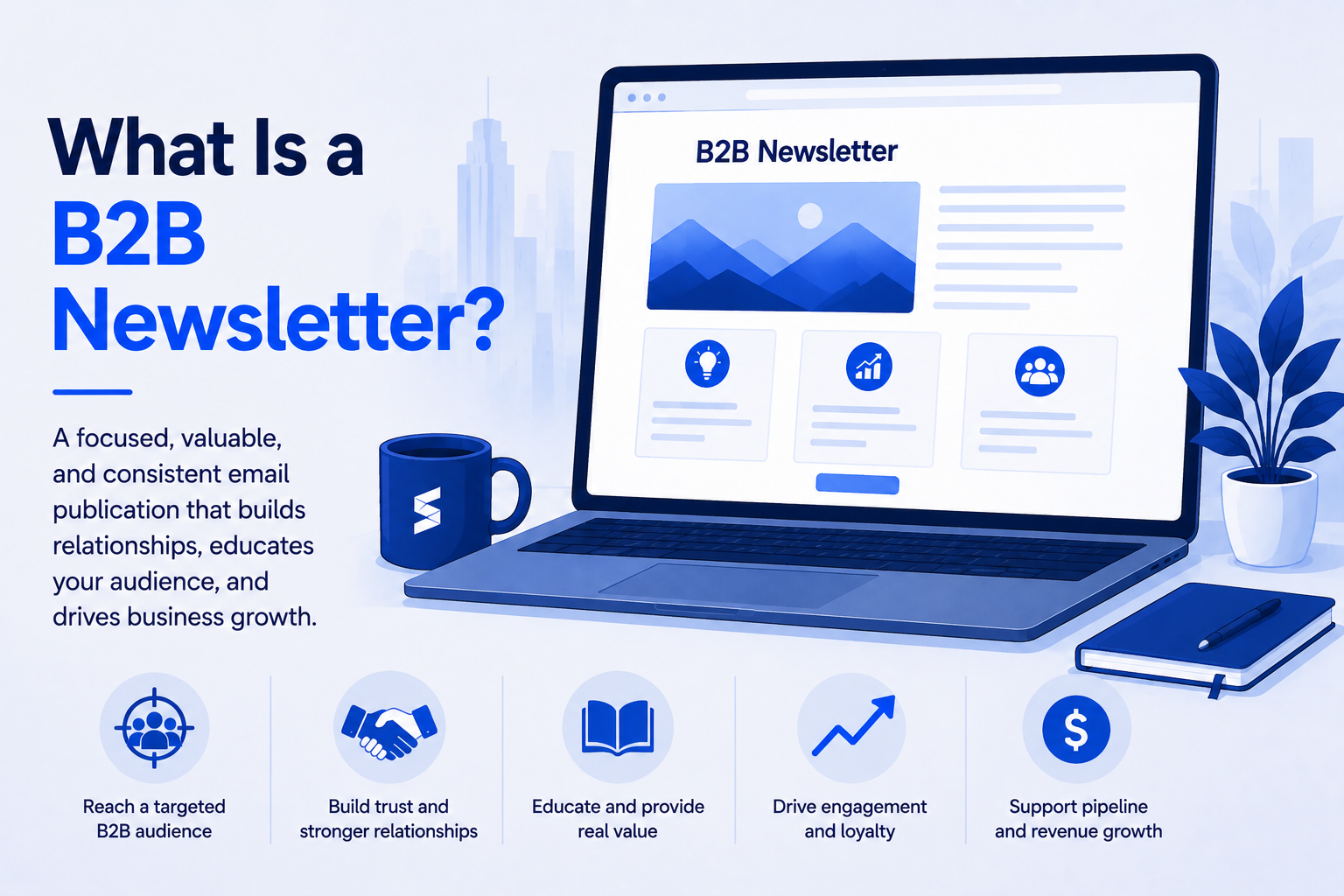
What Is a B2B Newsletter? (And How It's Different From a Consumer One)
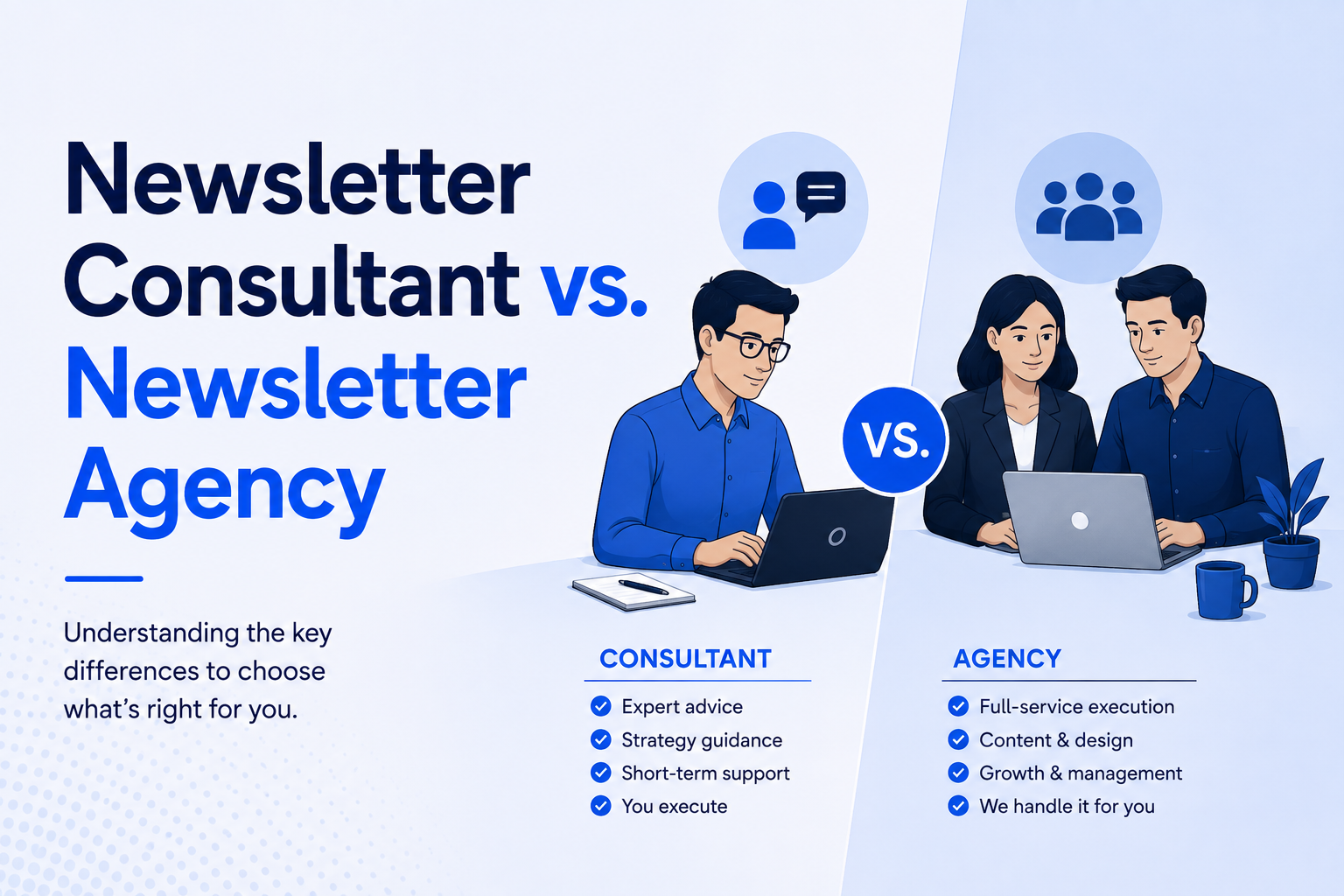
Newsletter Consultant vs. Newsletter Agency: Which One Actually Moves the Needle?
What Is a B2B Newsletter Agency (And What They Actually Do)