Newsletter vs. Webinars: Where Should B2B Marketing Teams Invest First?
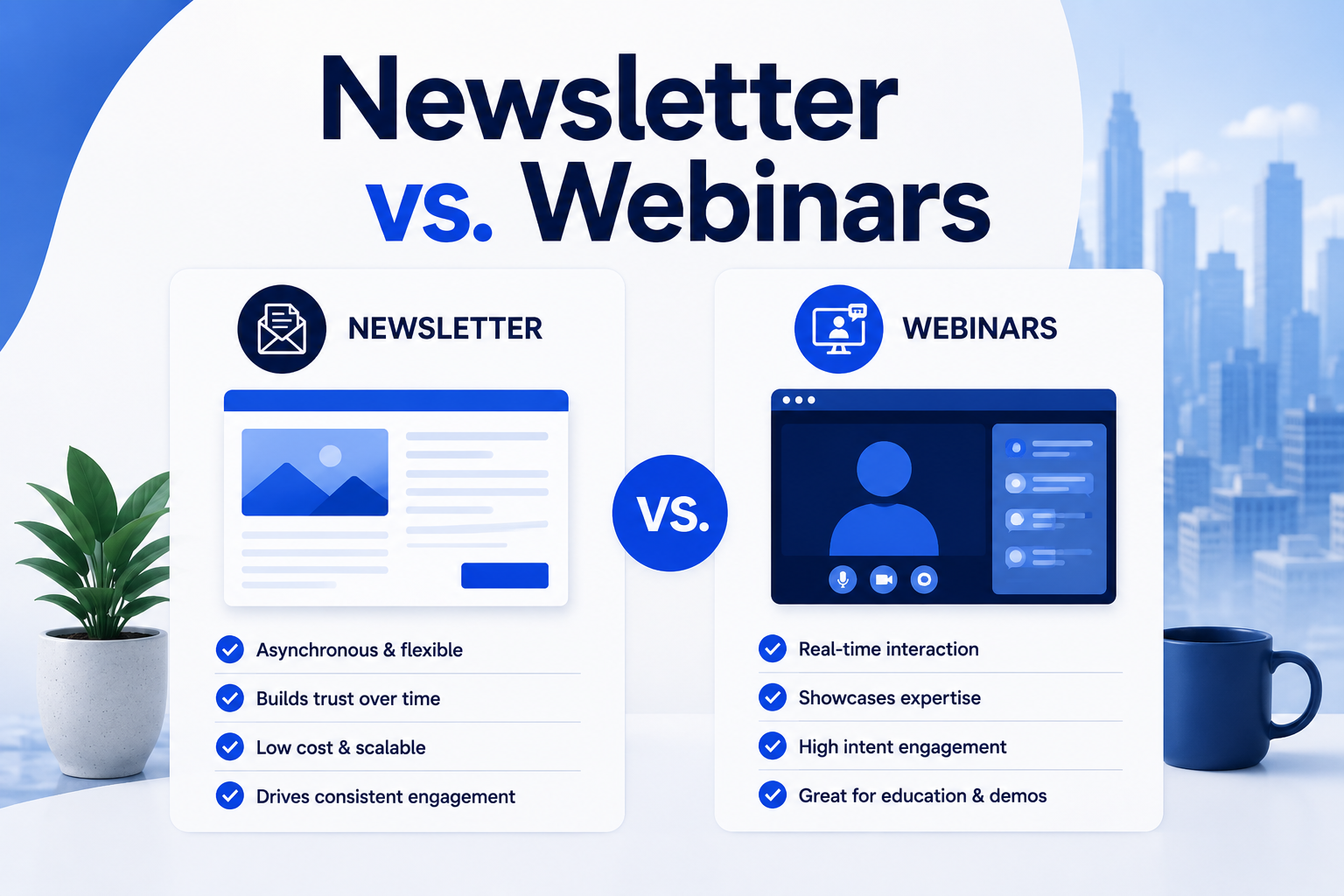

A webinar can fill a pipeline report in a single afternoon. A newsletter takes months to show up on the same report at all. That difference alone convinces a lot of marketing teams to lead with webinars, and it's usually the wrong call for where most companies actually are.
What a Webinar Actually Does Well
Webinars compress a lot of persuasion into one sitting. A prospect who spends 45 minutes watching a product walkthrough or an expert panel has moved further down the funnel than one who reads a single newsletter issue. Registration numbers and attendance rates are easy to report on, and sales can follow up with attendees the same week with a clear, specific reason to reach out.
That makes webinars a strong tool for a specific job: converting people who are already close to a decision. A prospect three calls into an evaluation benefits enormously from a deep-dive session. A stranger who's never heard of the company gets far less out of registering for one, if they register at all.
What a Newsletter Actually Does Well
A newsletter's advantage is reach and patience. It costs almost nothing to include someone who isn't ready to buy yet, so the list can include hundreds or thousands of people a webinar program would never justify inviting to a live session. Over months, that list becomes an asset: subscribers who've quietly built trust before a rep ever reaches out.
The tradeoff is speed. A newsletter issue rarely converts a reader into a lead in the way a webinar registration does. It's playing a longer game, and it needs months of consistent sending before the effect is visible in a pipeline report.
The Actual Trade-off: Effort Per Touch vs. Number of Touches
A webinar takes real production effort concentrated into one event: securing speakers, building slides, promoting registration, running the session, following up. All of that effort produces one touchpoint with each attendee.
A newsletter spreads a similar amount of effort across fifty-two touchpoints a year instead of one or two big events. Each individual issue asks less of the reader and delivers less all at once, but the cumulative relationship it builds over a year is different in kind, not just in degree, from what a handful of webinars can produce.
Where Budget Should Actually Go First
For a company with no existing audience and a founder or expert with something real to say, the newsletter is the better first investment. It builds the list that future webinars, product launches, and outbound campaigns will all draw on. Running webinars before that list exists usually means paying for registrations through ads, which gets expensive fast and produces one-off attendees instead of a compounding asset.
For a company that already has a reasonably sized list and needs to speed up deals already in motion, a webinar can be the faster lever. It's a tool for moving people who are close, not for building the audience of people who aren't close yet.
We've written about the closely related sequencing question between a newsletter and a blog here, and the logic carries over: build the owned audience first, then use higher-effort formats to convert pieces of it.
They Work Best as a Sequence, Not a Choice
The strongest version of this uses the newsletter to build and warm an audience, then brings in a webinar periodically to convert the portion of that audience that's ready to go deeper. A newsletter with 2,000 subscribers can promote a single webinar to exactly the right people, at close to zero additional acquisition cost, because the audience already exists.
Run it in the other order, cold webinar promotion with no existing list, and every registration has to be paid for or hustled individually, with no compounding return the next time.
What a Webinar-First Approach Usually Looks Like in Practice
A company with no newsletter and no existing list decides to run a webinar to generate leads for a new product. Registration gets promoted through paid social and a handful of partner emails. Forty people register, twelve show up live, and the sales team follows up with all twelve. Maybe two turn into real opportunities.
That's not a bad outcome for a single event, but it's also the entire result. Nothing compounds. The next webinar starts from zero again, with the same paid promotion cost and the same small conversion pool, because there was never a list built up in between events to draw on for free. Run the same company's budget into a newsletter instead for six months first, and the second webinar promotes to a warm list that costs nothing to reach and converts at a meaningfully higher rate, because those subscribers already know who's asking them to register.
What to Do Next
If your team is choosing where to spend the next quarter of marketing effort and doesn't have an existing audience to draw on, the newsletter is very likely the better starting investment, even though the payoff takes longer to show up.
Your newsletter won't build itself.


Newsletter vs. Podcast: Which Content Format Builds More Trust for B2B Brands?
Newsletter vs. Webinars: Where Should B2B Marketing Teams Invest First?
Newsletter vs. Cold Email/Outbound