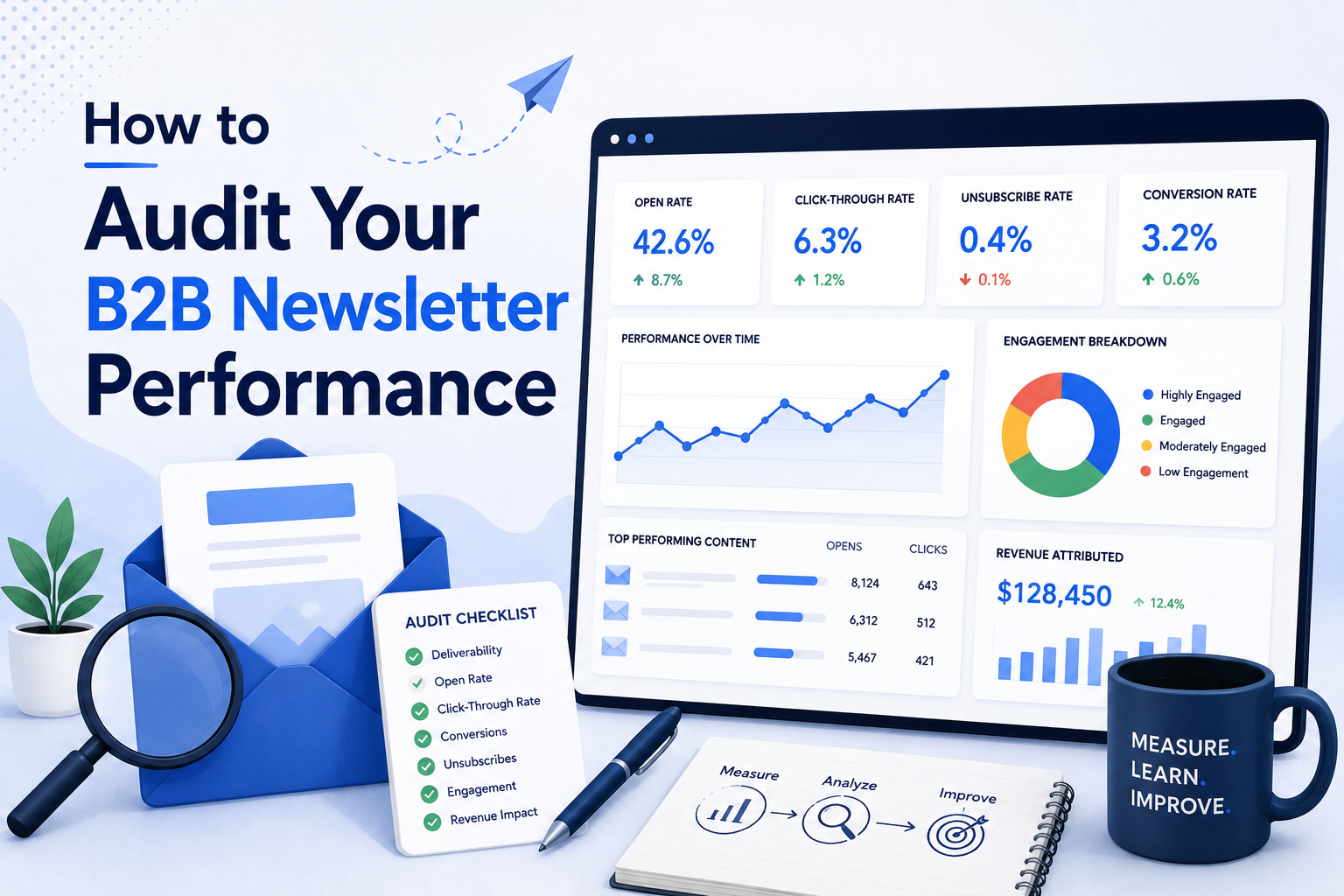
The B2B Newsletter Metrics That Actually Matter (And the Ones to Stop Obsessing Over)


If you ask most B2B marketing teams how their newsletter is performing, they'll tell you the open rate. It's the number that appears first in every email platform dashboard. It's the number that gets reported to the CEO. It's also the number that tells you the least about whether your newsletter is actually working.
This post makes the case for measuring differently. Not because open rate is useless ,it isn't, but because the metrics that actually predict whether a B2B newsletter will generate pipeline are almost never the ones being tracked.
Here's what to measure instead.
Why Open Rate Isn't the Best Metric
Open rate became the default newsletter metric because it was the easiest one to capture. A tracking pixel embeds in the email. When the email loads, the pixel fires. The platform records an open.
That system was always imperfect. It became significantly less reliable in September 2021, when Apple launched Mail Privacy Protection — a feature that pre-loads email content in the background before the user opens the email. The pre-load fires the tracking pixel. The platform records an open. But no human actually opened the email. These are phantom opens: recorded engagement that never happened.
Depending on how much of your audience uses Apple Mail and in B2B, that number is high your open rate could be inflated by 20, 30, or 40 percentage points. If you've been reporting a 65% open rate in your monthly newsletter update, you may have been reporting a number that's meaningfully wrong. That's an uncomfortable realisation, but it's better to know now than to keep optimising the wrong metric.
Even before Apple's change, open rate had a deeper problem: it measures the wrong thing. Open rate measures whether your subject line was compelling and whether the email landed in the inbox. It tells you nothing about whether the person who opened it read it, found it useful, or took any action because of it.
Stop leading your newsletter reporting with open rate. Teams that keep doing so end up optimising for subject lines while missing the signals that would tell them the newsletter isn't resonating — until the churn data finally shows up months later. Still track open rate — a significant drop signals a deliverability or subject line problem — but stop treating it as the measure of success.
The Metrics That Actually Predict Newsletter Success
Reply rate
Reply rate is the single most undervalued metric in B2B newsletter measurement and the one that tells you the most.
When a subscriber replies to a newsletter issue, something significant has happened. They read the content. They had a reaction strong enough to make them act on it. They took the time to write a response and hit send. In a medium where most people read passively, a reply represents genuine engagement.
For B2B, replies are also the beginning of sales conversations. A prospect who has been reading your newsletter for three months and replies to an issue about a problem they're facing has effectively raised their hand. That reply deserves a human response, not an auto-acknowledgement. Track how many newsletter replies convert to sales conversations each month. The number will surprise you.
A healthy reply rate for a B2B newsletter is 1-3%. Above 3% is excellent. Below 0.5% consistently signals that your content isn't generating enough of a reaction — either because it's too safe, too generic, or not hitting the right nerve with the right audience.
To improve reply rate: end every issue with a direct question. Be more opinionated. Share something counterintuitive. The replies follow when readers feel something.
Click-to-open rate
Most platforms report click rate — the percentage of your total list that clicked a link. Click-to-open rate (CTOR) is more useful: the percentage of people who opened the email and then clicked something.
The distinction matters because click rate inherits all the problems of open rate. If your open rate is inflated by phantom opens, your click rate looks worse than it is. CTOR removes that distortion. It asks a cleaner question: of the people who actually engaged with this issue, how many found something worth clicking?
CTOR between 10% and 15% is solid for B2B newsletters. Above 15% is strong. Consistently below 8% suggests your content is being read but not acted on — which usually means the CTAs are too vague, the content isn't relevant enough, or subscribers are opening out of habit rather than genuine interest.
To calculate CTOR: divide your total clicks by your total opens, then multiply by 100.
Subscriber quality
This is the metric almost no B2B newsletter team tracks, and it may be the most important one for connecting newsletter performance to revenue.
Subscriber quality measures what percentage of your list matches your ICP. A list of 1,000 subscribers where 700 are your ideal customer profile is more valuable than a list of 5,000 where 500 are. The first list will generate more pipeline. The second will generate better-looking dashboard numbers.
How to measure it: export your subscriber list and run it through a data enrichment tool, or manually audit a sample of 100 subscribers. Look at job title, company size, and industry. Compare against your ICP definition. What percentage match?
A subscriber quality rate above 50% is strong for a B2B newsletter growing through multiple acquisition channels. If your quality rate is falling — meaning new subscribers are less ICP-matched than existing ones — your acquisition tactics are reaching the wrong people and need adjusting.
Run this audit quarterly. It takes less than an hour and tells you something about your newsletter health that no platform dashboard will show you.
Pipeline influence
Pipeline influence is the hardest metric to set up and the most important one to have.
Tag every newsletter subscriber in your CRM with a property that identifies them as a subscriber. From that point forward, track the overlap between your subscriber list and your pipeline — opportunities created, opportunities won, and revenue closed.
What you're looking for: do newsletter subscribers convert to customers at a higher rate than non-subscribers? Do they have shorter sales cycles? Higher average contract values? In our experience working with B2B clients, the answer to all three — higher conversion rate, shorter sales cycle, higher contract value — is consistently yes. But you won't be able to prove it or report it to your CEO without the tagging in place.
Set this up before your next issue goes out. It takes roughly 15 minutes in most CRMs and gives you the attribution story you'll need to justify the newsletter investment internally.
Subscriber growth rate and churn rate
Track these together, not separately.
Subscriber growth rate tells you how fast your list is growing month over month. Churn rate tells you what percentage of your list unsubscribes each month. Net growth rate — new subscribers minus unsubscribes, divided by your starting list size — tells you whether the newsletter is building an asset or running in place.
Healthy B2B newsletter benchmarks:
- Monthly churn below 0.5% indicates content is resonating with the people who subscribed
- Monthly churn above 2% consistently is a content problem: subscribers expected something different from what they're getting
- Month-over-month list growth above 5% is strong for an established B2B newsletter
If growth is flat but churn is low, the newsletter is healthy but acquisition needs more attention. If churn is high, fix the content before scaling acquisition. Paying to bring in subscribers who leave within a month is an expensive way to go nowhere.
Two More Metrics Worth Tracking
Forward rate
When a subscriber forwards your newsletter to a colleague, your content has passed the highest test: it was useful enough that someone wanted another person to see it. Forwarding is the B2B equivalent of social sharing. It reaches exactly the right audience — people who look like your current subscribers, referred by someone they already trust.
Most platforms don't track forwarding natively. Beehiiv captures some of this data. Alternatively, add a "forward to a colleague" link at the bottom of each issue using a trackable URL, which lets you count how often it's clicked.
In our experience, a forward rate above 1% is strong for B2B newsletters. Even a handful of forwards per issue compounds over time — five forwards per issue across 50 issues reaches 250 additional readers who arrived through a trusted referral, not a cold acquisition channel.
Read time or scroll depth
Some platforms, including Beehiiv, estimate how long subscribers spend reading each issue. If your open rate is high but your read time is consistently under 30 seconds, subscribers are opening and immediately disengaging. That's a content or format problem, not a subject line problem.
A significant drop in read time across consecutive issues is an early warning signal. Subscribers who disengage quietly — opening but not reading — are the ones most likely to unsubscribe before you've had a chance to win them back with a stronger issue.
The One Metric That Matters Most
If you had to track only one number, track reply rate.
Open rate measures whether your email arrived and your subject line worked. CTOR measures whether your content was compelling enough to drive a click. Subscriber quality measures whether the right people are on your list. Pipeline influence measures the downstream revenue outcome.
Reply rate measures the relationship.
A subscriber who replies is reading, engaged, and in a conversation with you. That conversation is the beginning of trust, and trust is what shortens sales cycles and increases close rates. The newsletters that generate serious pipeline aren't necessarily the ones with the highest open rates or the most sophisticated automations. They're the ones where the editor wakes up on a Wednesday morning to twelve replies in their inbox and has to decide which ones to respond to first.
Write for that. Ask a question at the end of every issue. Share something that provokes a reaction. Make your newsletter worth responding to, and the metrics will take care of themselves.
Not sure how your newsletter currently performs against these benchmarks? Spacebar Studios offers a free newsletter audit for B2B companies.
We review your current metrics, identify the gaps, and give you a clear picture of where to focus first. We've done this for 50+ B2B companies. Book your free newsletter audit here
Subscribe to our newsletter the Growth Curve. One issue a week, written by humans, on what’s actually working in B2B newsletter marketing.
Your newsletter won't build itself.


How Much Does a B2B Newsletter Agency Cost?

Newsletter Management Services: What's Actually Included (A Breakdown)

How to Choose a B2B Newsletter Agency: The Evaluation Criteria That Actually Matter