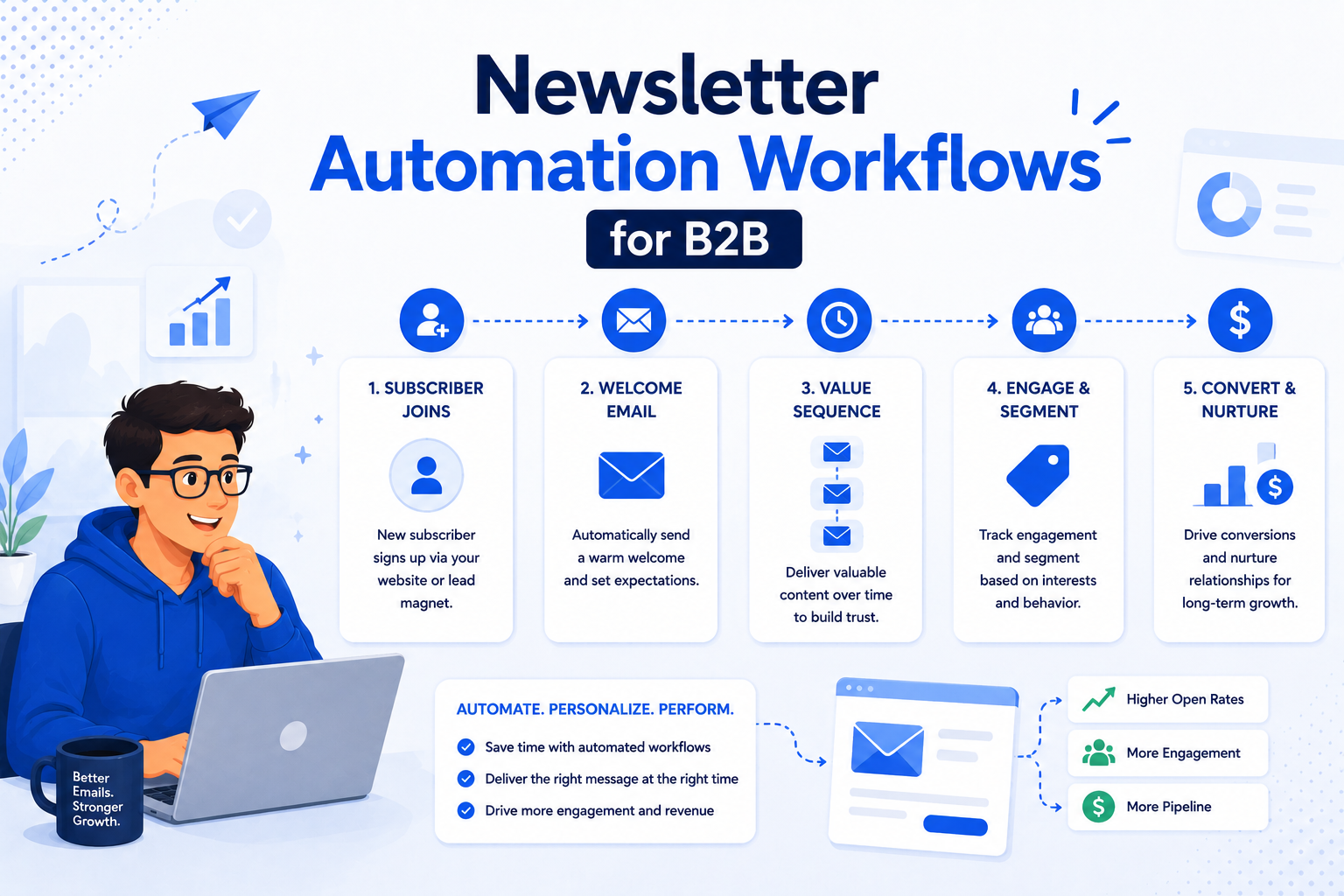
Why Most B2B Newsletters Underperform, and What to Do About It


There’s a quiet frustration happening inside a lot of B2B marketing teams.
They’ve launched a newsletter. They’re sending regularly. The content isn’t bad. But the numbers are... disappointing. Open rates are dropping. Clicks are flat. The subscriber count hasn’t moved in weeks. And most painfully, it’s not doing much to drive pipeline.
Sound familiar?
You’re not alone. The truth is, most B2B newsletters underperform — not because marketers are lazy or unskilled, but because the format is misunderstood. A newsletter isn’t just a distribution channel. It’s an owned media product. And if it’s not treated like one, it won’t perform like one.
Let’s break down why most newsletters fall flat — and what to do differently.
1. Readers Don’t Trust It Yet
It’s not that your audience hates newsletters. In fact, email is still one of the highest ROI channels in B2B, with some studies reporting returns of $36–$42 per $1 spent.
But trust is fragile in the inbox. If your newsletter doesn’t show up with consistent value, tone, and formatting, readers quickly tune it out.
Inconsistency is a killer. One week you’re sharing product news, the next it’s a random blog roundup, then a week goes by with nothing. That breaks the rhythm. And once someone stops opening, it’s incredibly hard to win them back.
Instead, make your newsletter a promise. Same day. Same voice. Same structure. Over time, that consistency builds trust — and trust builds attention.
💡 Pro tip: The best newsletters aren’t flashy. They’re predictable, useful, and clear on who they’re for.
2. There's No Built-In Reason to Take Action
You can publish the most insightful content in the world — but if there’s no soft call to action, no next step, no moment of momentum — it doesn’t go anywhere.
This is where most newsletters lose steam. They forget to build conversion paths into the experience. Not everything needs to drive to a demo request, but every issue should create a small moment of movement.
Some simple, effective CTAs:
- “Know someone who’d find this helpful? Forward it to them.”
- “Want more like this? Check out our teardown of [related content].”
- “Hit reply and tell me where this landed for you.”
The goal here isn’t to sell — it’s to spark action. That’s how you build loops, not just lists.
3. Growth Flatlines After the First Few Hundred Subscribers
Most newsletters grow quickly in the first month. You announce it on LinkedIn, your teammates share it, a few warm leads sign up. Then growth slows… and eventually stalls.
Why?
Because you’ve run out of warm audiences — and you’re not seeding cold ones.
If you want to grow a newsletter in 2025, you can’t rely on passive footers or buried sign-up links. You need to treat growth like a distribution problem. Where does your audience already hang out? Are you showing up there consistently — with content that links back to your newsletter?
Also, your signup pitch matters. Saying “Weekly insights and updates” isn’t enough. What’s the hook? What makes this newsletter different from the 50 others in their inbox?
📊 Data point: Newsletters with niche-driven positioning grow up to 2.5x faster than generalist ones (Beehiiv, 2025).
4. You’re Sending Consistently — But Value Isn’t Evolving
Just because you're consistent doesn't mean you're improving. If engagement is trending down even though you’re sending regularly, there’s likely a deeper issue: content fatigue.
Your audience isn’t unsubscribing… but they’ve stopped caring.
This usually happens when the content becomes too familiar. Same layout. Same tone. Same takeaways. Readers can skim the subject line and already know what’s inside — and that’s not a good thing.
It doesn’t mean you need to overhaul everything. Sometimes a small shift makes a big difference:
- Introduce rotating themes or segments
- Add reader feedback loops (e.g. “What should we cover next?”)
- Drop in surprise formats — an AMA, a rant, a teardown
Think of your newsletter like a playlist. You want consistency, yes. But you also need enough variety to keep people pressing play.
5. The Newsletter Isn’t Structured to Scale
Even if the content is strong, a lot of B2B newsletters fall apart operationally. They’re cobbled together each week, with no template, no format, and no editorial plan.
That makes them hard to maintain — and impossible to hand off.
To fix this, treat your newsletter like a product:
- Define your positioning (who it’s for, what it promises, how it’s different)
- Use a repeatable structure (e.g. Hook → Insight → CTA → Bonus link)
- Build distribution and feedback into every issue
When you do that, your newsletter becomes more than a channel. It becomes an engine. Something that attracts, educates, and converts over time.
The Fix: Rebuild Your Newsletter as a Growth Asset
You don’t need to start over. But you might need to rebuild the foundation.
Here’s a basic framework you can use:
1. Clarify the Promise
What do subscribers get — every single time? Make it specific. Make it useful. Make it obvious.
2. Standardize the Format
Create a template you can follow every week. This saves time, improves consistency, and makes delegation easier.
3. Layer in Growth Loops
Add share prompts, referral links, or exclusive content incentives. Make each issue easier to discover and share.
4. Track What Matters
Don’t obsess over single open rates. Watch for trends. Look for replies. Track clicks to high-intent content or conversion pages.
Bottom Line: Make Your Newsletter Worth the Scroll
If your newsletter feels like work to produce and does little in return, something’s off.
But that doesn’t mean newsletters don’t work — it means yours needs a strategy.
When you treat your newsletter as an owned media product — with structure, positioning, and a clear path to value — you unlock something most B2B teams never will: an audience that wants to hear from you. That’s how you win attention. Build trust. And drive real results.
Want to fix your newsletter?
Book a 30-minute strategy session with our team and see if there’s a fit.
Your newsletter won't build itself.


Newsletter Consultant vs. Newsletter Agency: Which One Actually Moves the Needle?

What Is a B2B Newsletter Agency (And What They Actually Do)

What Does a Good B2B Newsletter Actually Look Like?