How to Turn Your Newsletter Into LinkedIn Posts (and LinkedIn Posts Into Newsletter Issues)

Most B2B marketing teams think they need separate ideas for every channel.
A LinkedIn post needs its own idea. The newsletter needs its own idea. The blog needs its own idea. So the team spends its time generating content instead of thinking, and burns out trying to fill every channel with original thinking that never quite lands anywhere.
There's a better model. One where your newsletter and your LinkedIn presence feed each other — where the same thinking compounds across both channels instead of being consumed by one.
The Two-Way Street Between Newsletter and LinkedIn
Your newsletter and LinkedIn aren't competing for your content. They're two different formats for the same audience.
Your newsletter subscribers are often your LinkedIn followers. Your LinkedIn followers are candidates to become newsletter subscribers. The thinking you develop in one place has a ready audience in the other.
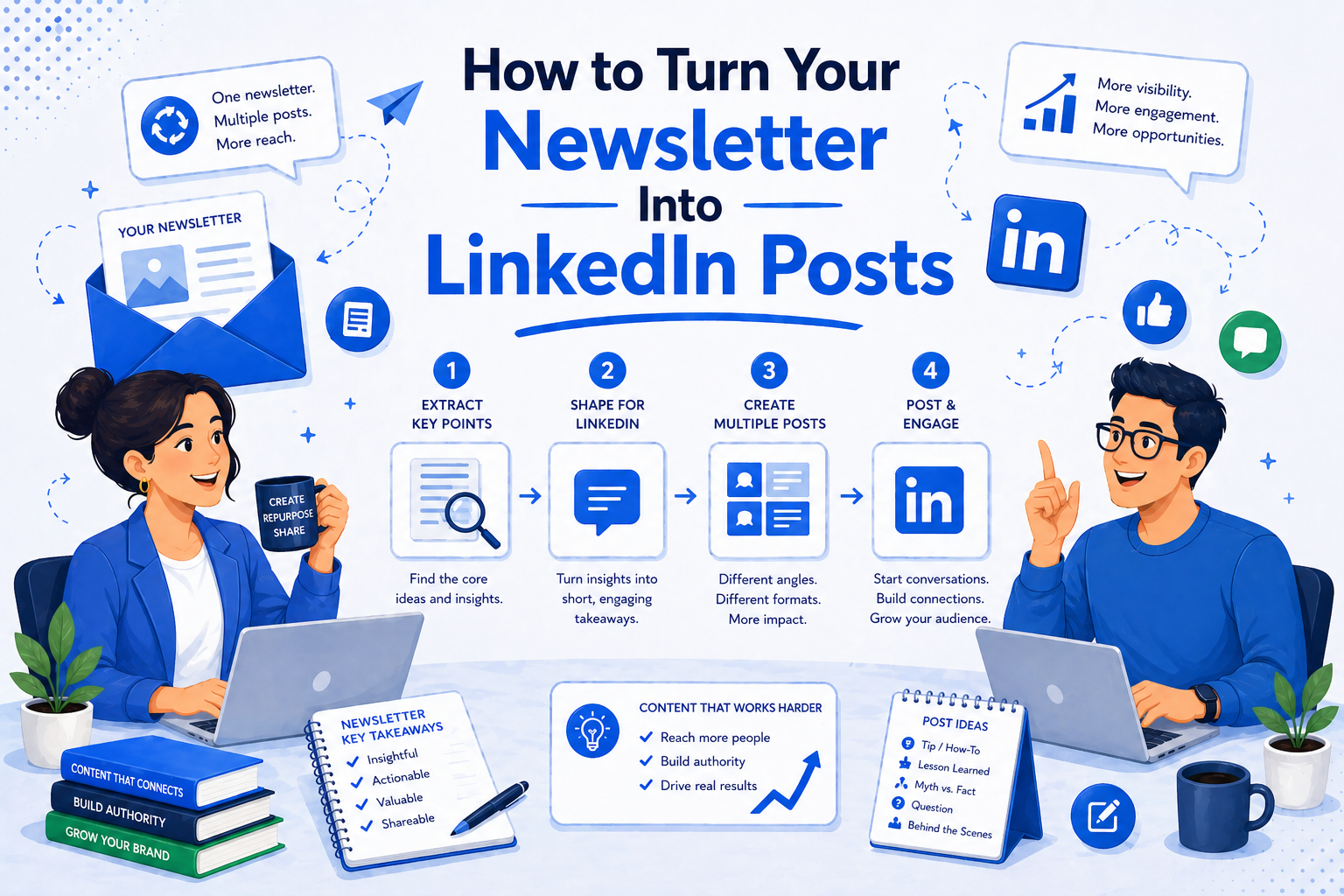
Direction one: newsletter becomes LinkedIn. Direction two: LinkedIn tells you what to put in your next newsletter. Both directions work. The system compounds when you use both.
Direction 1: Newsletter to LinkedIn
You write a newsletter. It goes out to your list. Twenty-four hours later, 80% of your subscribers have either opened it or moved on.
Meanwhile, that same thinking is invisible to your LinkedIn audience.
Here's the workflow: pick one insight from your most recent newsletter issue. Not the whole issue — one paragraph, one observation, one counterintuitive point. The sharpest thing you said. Strip it down to a hook post.
A newsletter section that reads: "Most B2B companies treat email as a broadcast channel. The ones seeing the best results treat it as a conversation channel."
Becomes a LinkedIn post that opens: "Reply rate is the email metric most B2B newsletters ignore. Here's why that's a mistake."
This does three things. It extends the reach of your newsletter thinking beyond your existing list. It gives your LinkedIn audience a reason to subscribe. And it keeps your LinkedIn presence consistent without requiring a separate ideation process.
Important: don't copy-paste the full newsletter section into LinkedIn. Rewrite it for the format. LinkedIn rewards punchy, scannable text. Compress it. Sharpen the hook.
Direction 2: LinkedIn to Newsletter
Your LinkedIn posts are research.
Every post you publish is a small experiment. You're testing an idea in public and watching what happens. Which posts generate comments? Which ones get shared? Which ones prompt people to reply to you directly?
The engagement data tells you something important: what your audience actually wants more of.
A post about your view on cold outreach gets 40 comments. One about your company's product update gets 3. That's signal.
The posts that generate real engagement — questions that dig into the idea, DMs from people who want to talk more — those are your next newsletter topics.
At the end of each week, look at your last five to seven LinkedIn posts. Find the one that performed best by engagement quality. Then ask: what did this post scratch the surface of that your newsletter could fully develop? A 200-word LinkedIn post that got strong engagement becomes a 600-word newsletter section.
The Weekly Workflow in Concrete Steps
On the day you send your newsletter, identify the sharpest single insight in the issue. Write a LinkedIn post around it that evening or the next morning. End the post with a link to subscribe.
During the week, post on LinkedIn normally — industry takes, observations, short frameworks. Track what you post.
At the end of the week, note which post generated the most engagement. Write that topic idea into your newsletter planning doc for the following issue.
That's it. Newsletter informs LinkedIn. LinkedIn informs newsletter. One body of thinking instead of two.
Why This Approach Works
When your audience sees the same perspective in their inbox and in their LinkedIn feed, something happens: you stop being a content source and start being a voice they trust. They don't just know what you think about X — they know how you think.
B2B buying decisions don't happen in one touchpoint. Every time they see consistent, useful thinking from you in either place, that readiness compounds.
What Not to Do
Do not copy-paste your full newsletter into a LinkedIn post. It fails in two directions at once: LinkedIn's algorithm deprioritizes wall-of-text posts, and your newsletter subscribers who see the full text on LinkedIn have no reason to stay subscribed.
Similarly, don't take a LinkedIn post that got zero engagement and try to expand it into a newsletter section. The signal only works when there is signal.
What to Do This Week
Look at your last newsletter issue and find the one paragraph that said the most interesting thing. Write a LinkedIn post around that single idea. Keep the opening line sharp. Add a subscribe link at the end.
Then look at your last ten LinkedIn posts. Find the one that generated the most genuine engagement. Add that topic to your next newsletter issue as a section to develop fully.
Book a free strategy call with Spacebar Studios if you want a content system built around this kind of thinking — newsletter strategy, LinkedIn alignment, all done for you.